What if the fastest way to understand dumpster rental pricing is to stop guessing at a number and start with your project details? A quote can be hard to compare when you don’t know what it covers, and choosing a container that’s too small can slow down a cleanup or renovation. The debris you’re removing and the space available for delivery matter, too.
It’s reasonable to want a clear budget before work begins. The good news is that a few practical details can make a quote more useful and help you plan with confidence. This guide explains the main factors that shape pricing, what to review when comparing quote inclusions, and which project details to gather before requesting a quote.
For residential and commercial cleanups around Groves and nearby Southeast Texas communities, Rapid Rolloff Dumpsters LLC offers 20-yard and 40-yard hook lift dumpsters and 30-yard dumpsters, with delivery and pickup. You’ll learn how project scope, debris type, loading plans, and delivery logistics can influence your choice, so you can select a practical container and keep your cleanup moving without relying on guesswork.
Key Takeaways
- Understand how dumpster rental pricing can change with project scope, container size, debris, and delivery logistics.
- Review quote terms side by side, including rental, delivery, pickup, disposal, and any potential additional charges.
- Match a 20-yard, 30-yard, or 40-yard dumpster to the scale of your cleanup without relying on assumed capacity or weight limits.
- Prepare your project location, debris types, access conditions, and preferred delivery timing before requesting a quote.
- See how Rapid Rolloff Dumpsters’ options can support residential and commercial cleanup projects around Southeast Texas.
What Does Dumpster Rental Pricing Depend On?
Dumpster rental pricing is a project-specific quote shaped by the container selected and the service details needed to deliver, place, and pick it up. Two cleanups can receive different quotes without either being unusual. A home renovation with dense construction debris has different needs from a commercial cleanout with lighter, bulkier materials. The location, access to the drop-off area, and requested rental arrangements also help define the work involved.
Think of the quote as a combination of separate considerations, not simply a number attached to a container. Size relates to the amount and kind of debris. Debris type can affect how a load is handled. Delivery and pickup require a workable location and access plan. Service terms describe what the quoted amount covers. The details matter because a price based on an incomplete project description may not reflect what the cleanup actually requires.
A price estimate is a planning figure; a confirmed project quote reflects the container and service details provided for the specific cleanup.
Which details influence a dumpster rental quote?
Start with the project debris. A small room cleanout may call for a different container than a whole-home renovation or a commercial site cleanup. Material matters, too: bulky household items and dense renovation debris take up space and behave differently in a container. Rapid Rolloff Dumpsters offers 20-yard and 40-yard hook lift dumpsters and 30-yard dumpsters, giving residential and commercial projects several size options to consider.
Then describe how the container will be delivered and used. The roll-off format involves more than selecting a size; the Roll-off (dumpster) overview explains the basic container and hauling setup. Share where the container should go, what access looks like, and the expected project timing. Quote terms can vary, so read what is stated about rental, delivery, pickup, disposal, and possible additional charges rather than assuming these are handled the same way in every quote.
Why local project details matter around Groves
Delivery planning is specific to the property. In Groves or a nearby Southeast Texas community, a clear driveway with open placement space presents a different access plan from a narrow approach, a sloped area, or a crowded worksite. These details help the delivery team plan a practical placement. They don’t, on their own, establish a particular fee or local requirement.
Before requesting a quote, note the project address, likely debris materials, preferred placement area, and any access obstacles, such as gates, parked vehicles, or limited turning room. For example, a renovation crew may need the container close to the work area, while a residential cleanout may have more placement flexibility. Sharing these details helps connect the container choice to the actual cleanup and makes the quote easier to understand. Rapid Rolloff Dumpsters is based in Groves and provides dumpster rental, delivery, and pickup for nearby residential and commercial projects.
What Should a Dumpster Rental Quote Spell Out?
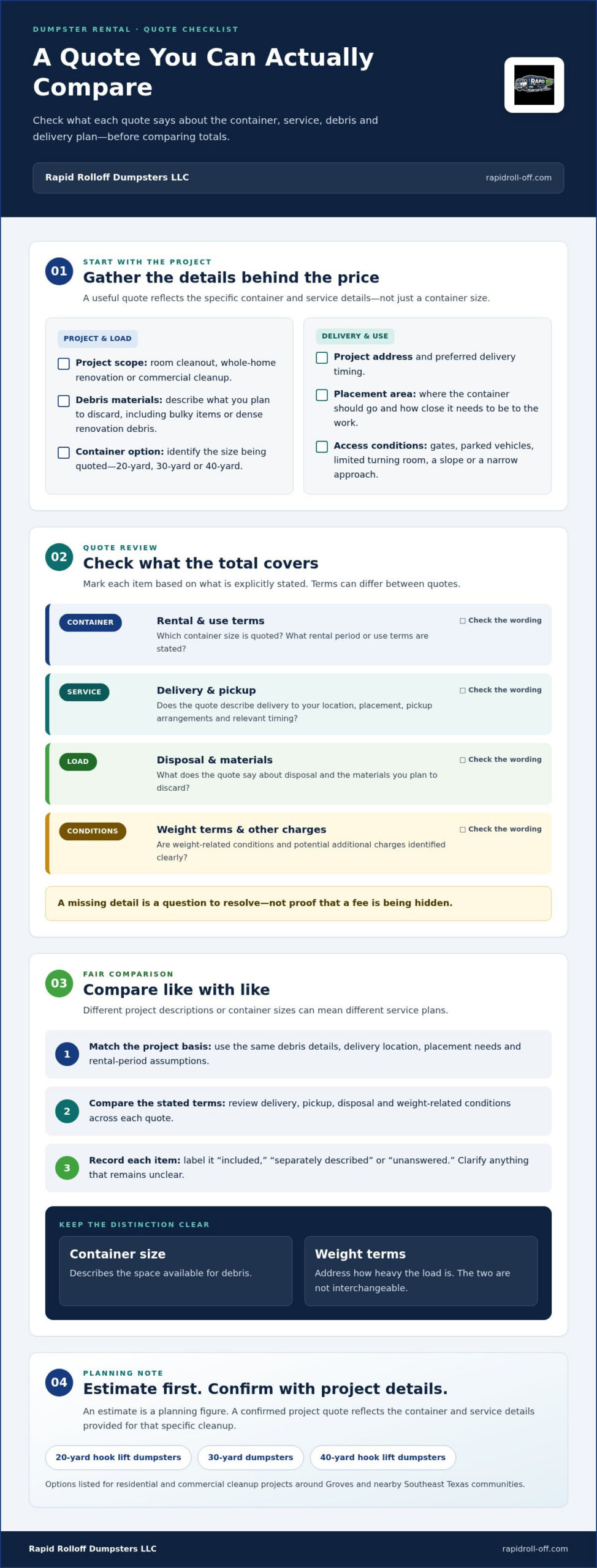
A quote is easiest to compare when you can see which container and services it describes. Don’t assume that delivery, pickup, disposal, or a particular rental period is included just because a quote gives one total. Terms can differ, so focus on what each quote explicitly states and which project details it’s based on.
Use this checklist to review the details:
- Container rental: Which container size is quoted, and what rental period or use terms are stated?
- Delivery: Does the quote describe delivery to your project location and the placement plan?
- Pickup: Are pickup arrangements and any relevant timing terms explained?
- Disposal: What does the quote say about disposal and the materials you plan to discard?
- Weight: Are weight-related terms or conditions clearly described?
- Other charges: Are potential additional charges identified, or are those terms left unanswered?
A missing detail is a question to resolve, not proof that a provider is hiding a fee. For a project-specific starting point, you can request a dumpster rental quote based on your cleanup and location.
How to compare dumpster rental quotes fairly
Compare like with like. A quote for a 20-yard container isn’t directly comparable to one for a larger option, and different project descriptions can lead to different service plans. Make sure each quote uses the same debris details, delivery location, placement needs, and rental-period assumptions. Then compare what’s stated for delivery, pickup, disposal, and weight-related terms. This makes differences easier to understand without assuming that any particular item is automatically included.
As you review dumpster rental pricing, write down the stated terms in one place. Mark each item as included, separately described, or unanswered. If disposal language is unclear, describe the materials you expect to load and note the exact point you need clarified. The U.S. EPA provides information on the Resource Conservation and Recovery Act (RCRA), a federal framework for waste management. That reference offers broader context; it doesn’t establish what a specific rental quote includes.
What to clarify about weight and disposal terms
Container size describes the space available for debris, while weight terms address how heavy the load is. Those aren’t interchangeable. A container may have room for more material while the debris itself is dense, so the type and amount of waste can matter to disposal terms. Don’t assume a weight allowance or overage condition; look for the quote’s stated terms and identify what needs clarification.
Keep your material list practical. Note whether the cleanup involves household items, renovation debris, roofing materials, or another type of waste. Avoid mixing unlike quotes based on different assumptions about what’s being discarded. A future guide to dumpster rental weight limits can offer more detail on that topic; for now, treat any weight-related condition as a separate part of the quote to review before planning your load.
How Do Dumpster Size and Project Type Affect Pricing?
Container size is one part of dumpster rental pricing, not a price predictor on its own. A larger option may suit a broader cleanup, but the quote also reflects the project’s debris, delivery needs, and service terms. Choose based on the work you expect to do, not just the container’s label.
Let the project scope guide the container size: estimate the debris, consider its material, and match the option to the cleanup you’re planning.
| Container option | Project scale to consider | Planning note |
|---|---|---|
| 20-yard | A smaller cleanup or a focused renovation | Consider it when the expected debris volume is relatively contained. |
| 30-yard | A larger residential cleanout or renovation, or a commercial project | Useful to consider when the work may produce more debris than a smaller project. |
| 40-yard | A substantial cleanup or a project with a large amount of debris | Consider the expected volume and material before choosing; size alone doesn’t guarantee a fit. |
When a 20-yard, 30-yard, or 40-yard dumpster may fit
Rapid Rolloff Dumpsters offers 20-yard and 40-yard hook lift dumpsters and a 30-yard dumpster for residential and commercial projects. A 20-yard option may suit a smaller, well-defined job, while a 30-yard option gives larger cleanups another size to consider. For substantial debris, a 40-yard option may be appropriate. These are starting points, not promises of capacity or fit. Include the work scope and expected materials when requesting a project-specific quote.
Think through the sequence of the job, too. A kitchen renovation may generate debris in stages, while a commercial cleanout could involve materials from several rooms or work areas. If the pile is hard to estimate, list the rooms, structures, or areas involved and describe what will be removed. That gives a clearer basis for discussing size than a broad label such as “large cleanup.”
How debris type changes the project estimate
Volume and weight are different considerations. Bulky household items can take up considerable room without being as dense as some construction materials. Roofing debris, concrete, or other dense materials may load differently and make weight an important consideration. Don’t estimate by volume alone, and don’t assume that a container’s size tells you its weight terms. Describe the material mix so the project can be assessed more accurately.
For renovation or demolition work, the U.S. EPA’s Sustainable Management of Construction and Demolition Materials resource discusses ways to manage these material streams, including reuse and recycling. The materials you plan to discard can shape how you organize the cleanup, so keep reusable items separate from debris intended for disposal when practical. A future heavy-debris guide can help explain material planning, and a weight-limit guide can cover weight terms in more detail.
How Can You Plan a Dumpster Rental Budget Before Delivery?
A useful budget starts with a clear picture of the cleanup, not a guessed price. The more accurately you describe the project, the more relevant the quote can be. That won’t guarantee a particular price, but it helps connect the proposed container and service details to the work you actually need done.
Use this five-step process before requesting a quote:
- Define the scope. Note whether you’re handling a home cleanout, renovation, landscaping cleanup, or commercial project. List the rooms, work areas, or structures involved.
- Estimate the debris. Describe the approximate amount and the materials you expect to remove. Separate bulky items from dense construction debris in your notes.
- Choose a size to discuss. Use your project scope to consider a 20-yard, 30-yard, or 40-yard option. Treat this as a starting point, not a promise that a container will fit every load.
- Plan placement. Identify the preferred drop-off spot and note driveway or jobsite access, including gates, tight turns, slopes, or other obstacles.
- Review quote terms. Compare the stated container, delivery and pickup arrangements, rental terms, disposal language, and any weight-related conditions. Keep assumptions consistent as you review options.
A project checklist for a clearer estimate
Have these details ready: the project location, cleanup type, approximate debris volume, material types, access conditions, preferred placement area, and timing needs. Include a preferred delivery date or general timing window as a planning preference, not as an assumption about availability. These basics help describe the job clearly, whether it’s at a home or a commercial site.
For projects in Port Arthur, Beaumont, Nederland, Port Neches, Orange, or Bridge City, include the full location in your project notes. Even nearby cleanups can have different access and placement needs. A container planned for an open driveway may require a different delivery approach from one intended for a crowded jobsite. Clear notes help make those details part of the estimate discussion.
How to avoid budget surprises during cleanup
Before loading begins, review the quote terms and compare them with the materials and project scope you described. If the work changes, such as adding a room cleanout to a renovation, revisit your original assumptions instead of treating the new debris as part of the same plan. Keep material types and weight-related conditions in view; container space and load weight aren’t the same thing. A weight-limit guide can provide added context, but the terms stated for your project remain the practical reference.
Don’t load materials beyond the terms stated for the rental. If a disposal or weight condition is unclear, resolve that detail before filling the container so you can plan the cleanup with fewer unknowns. For a project-specific estimate based on your location, debris, access, and preferred timing, request a dumpster rental quote.
Get a Dumpster Rental Quote for Your Southeast Texas Project
A useful quote brings several details together: the work you plan to complete, the container size you’re considering, the debris you expect, and the rental terms that apply to the project. No single factor tells the whole story. A home cleanout and a construction cleanup may need different planning even if they take place at the same property.
Rapid Rolloff Dumpsters is based in Groves, Texas, and serves nearby Southeast Texas communities with dumpster rentals, delivery, and pickup for residential and commercial projects. Available options include 20-yard and 40-yard hook lift dumpsters and a 30-yard dumpster. Sharing clear project details makes it easier to discuss which option suits the cleanup and understand the quote terms. That’s a practical way to approach dumpster rental pricing without relying on assumptions.
Choose a container around the work you need to finish
Start with the job itself. For a home cleanout, list the rooms and kinds of items involved. For a renovation, describe the work areas and expected debris. A focused project may point toward considering a 20-yard option, while a larger cleanout or renovation may call for discussing a 30-yard or 40-yard container. These are planning prompts, not guarantees that a particular size will hold every load.
Commercial and construction cleanups benefit from the same project-specific approach. Note how many work areas are involved, what materials will be removed, and whether debris will be generated all at once or as work progresses. Don’t select a larger container based on a vague sense that it might be safer. A clear estimate of the work and debris gives you a better starting point for discussing size and service terms.
Request pricing with the right information ready
Before requesting a quote, gather the project location, a short description of the scope, expected debris types, and the preferred placement area. Add access details such as a narrow driveway, gate, or busy worksite entrance, along with your preferred delivery timing. These notes help describe the delivery plan and the cleanup itself. They make a quote more relevant, but they don’t guarantee a particular price or timing.
Review the quote as a whole, including the container and the stated delivery, pickup, disposal, rental, and weight-related terms. Rapid Rolloff Dumpsters’ rental service includes container delivery and pickup, helping keep the logistics connected to the project. If your plans change, update your description so the quote and cleanup assumptions still match. Clear information supports straightforward planning from container placement through pickup.
Have your project details ready? Request a dumpster rental quote for your Southeast Texas cleanup.
Put Your Cleanup Plan in Motion
Before you schedule a cleanup, turn your plan into a short project brief. Write down what you’re removing, where the container should sit, and what access or timing considerations could affect the work. This preparation gives your quote request a useful starting point and keeps planning grounded in the job ahead, not a guessed figure.
A clear conversation about dumpster rental pricing isn’t about chasing the lowest number in isolation. It’s about understanding how the proposed container and service terms align with your debris and the way your project will unfold. If the work will happen in stages, note which areas you’ll clear first and whether the debris types will change as the job progresses. Keep your project details handy so you can share a consistent picture of the cleanup.
Rapid Rolloff Dumpsters can help you take the next step for your Southeast Texas project. Share your prepared details to Request a dumpster rental quote for your project. A thoughtful plan makes it easier to move from preparation to a cleanup that feels manageable.
Frequently Asked Questions
How much does dumpster rental cost?
There isn’t one dependable price for every cleanup. Dumpster rental pricing depends on the project and the terms attached to its quote. For example, two homeowners clearing similar rooms may describe different debris or delivery access, which can affect how their projects are planned. To get a useful estimate, share the same project information each time you request pricing, then compare the stated terms rather than relying on a general figure.
What is usually included in dumpster rental pricing?
Inclusions vary by quote, so read the written terms instead of assuming the total covers every service. Look for descriptions of delivery, pickup, disposal, rental duration, and any weight conditions or other potential charges. One practical approach is to mark each item as stated, conditional, or unclear as you read. That helps you spot which parts of two Groves-area quotes may not be directly comparable.
Does dumpster size affect rental pricing?
Yes, size can affect a quote, but the label alone doesn’t determine the full amount. Think about how the debris will be generated: a single-room cleanout may be easier to estimate than a renovation with materials coming from several work areas. Rapid Rolloff Dumpsters offers 20-yard, 30-yard, and 40-yard options. Describe the project and materials so container selection reflects the cleanup, not just a guess based on size.
Can I get a dumpster rental quote before delivery?
Yes. Requesting pricing before delivery gives you a chance to plan around the container and the job. Include the location, cleanup type, debris estimate, material list, access conditions, and preferred timing. Rapid Rolloff Dumpsters is based in Groves and serves nearby communities, including Port Arthur, Beaumont, Nederland, Port Neches, Orange, and Bridge City. Sharing details early helps make the quote relevant to your project.
Can heavy debris change dumpster rental pricing?
It can. Dense materials, such as concrete or roofing debris, may affect disposal terms differently from bulky household items. Before loading, compare the materials you actually have with the conditions stated in your rental terms. Don’t assume a weight allowance or extra-charge policy. A dedicated dumpster rental weight-limits guide can provide more context when available, but the specific terms for your rental should guide how you plan the load.
How do I compare dumpster rental quotes?
Compare quotes only after aligning the project details behind them. Use the same cleanup description, debris types, container size, location, and placement information for each request. Then check whether the written terms address delivery, pickup, disposal, rental duration, and weight conditions. If one quote leaves an item unclear, treat it as an unanswered detail rather than assuming a charge applies. This gives you a more useful comparison than headline totals alone.
What dumpster size should I choose for my project?
Choose a size by estimating the work and debris, then use the estimate as a starting point for the quote discussion. Rapid Rolloff Dumpsters offers 20-yard and 40-yard hook lift dumpsters and a 30-yard dumpster. A room-by-room list can help with a home cleanout; for construction work, note each work area and material type. Share those details when requesting pricing so the container choice can be considered in context.