Clearing out a family home rarely stalls because of a lack of effort; it stalls because nobody planned where all the discarded belongings would actually go. Handling estate cleanout waste disposal while processing decades of personal keepsakes creates an immediate, exhausting bottleneck that can halt your progress before it even begins.
You’re likely juggling deep emotional fatigue, tight property listing deadlines, and competing family schedules. On top of that, uncertainty about prohibited landfill materials and the fear of heavy waste containers cracking the driveway only add unnecessary friction to an already stressful process.
You can regain control with a phased sort-and-contain strategy. This complete 2026 checklist helps you master your project with a step-by-step waste disposal system covering hands-on sorting methods, container sizing, and logistical timelines. Ahead, you’ll find the practical guidance needed to protect the property, prevent decision fatigue, and hand over a clean, empty home right on schedule.
Key Takeaways
- Secure executor documentation and complete a thorough sweep for vital financial records before removing any household items.
- Streamline your estate cleanout waste disposal by separating general household goods from regulated materials like wet paint and automotive fluids before work begins.
- Compare rental dumpsters against junk removal crews to balance your schedule, budget control, and hands-on sorting needs.
- Select container sizes based on square footage and utilize gentle hook lift delivery systems to keep driveways safe from scraping.
- Pack containers efficiently by walking heavy items through the rear door and breaking down bulky furniture to eliminate dead air space.
Phase 1 Checklist: Preparing for Estate Cleanout Waste Disposal
Jumping straight into clearing rooms creates immediate chaos. Before ordering containers or sorting belongings, you must secure proper legal authorization. Ensure you have the executor documentation, letters testamentary, or court appointment paperwork in hand before removing a single item from the premises. Discarding personal property without verified legal authority can trigger severe estate disputes and halt probate proceedings.
Once legalities are settled, equip your crew properly. Assemble heavy-duty leather work gloves, particulate dust masks, puncture-resistant boots, and 3-mil contractor cleanout bags. Schedule a focused walkthrough with heirs to tag sentimental keepsakes. Clear labeling up front prevents accidental disposal of family heirlooms and sets a firm baseline for your estate cleanout waste disposal plan.
Document Recovery and Asset Identification
Valuable assets and critical legal records hide in unexpected spots. Conduct a methodical sweep through desk false bottoms, unlabelled attic cartons, coat pockets, freezer storage boxes, and under-mattress cavities. Isolate and secure key records immediately:
- Real estate deeds, homeowner insurance policies, and mortgage satisfactions
- Tax returns, vehicle titles, and physical stock or bond certificates
- Military service discharge papers and personal identification records
- High-value collections, jewelry, stamp albums, and mid-century art pieces
Photograph and catalog every item with contested sentimental or financial value. Digital records safeguard transparency among family members and satisfy probate auditing requirements before final disposal starts.
Establishing the Four-Category Staging System
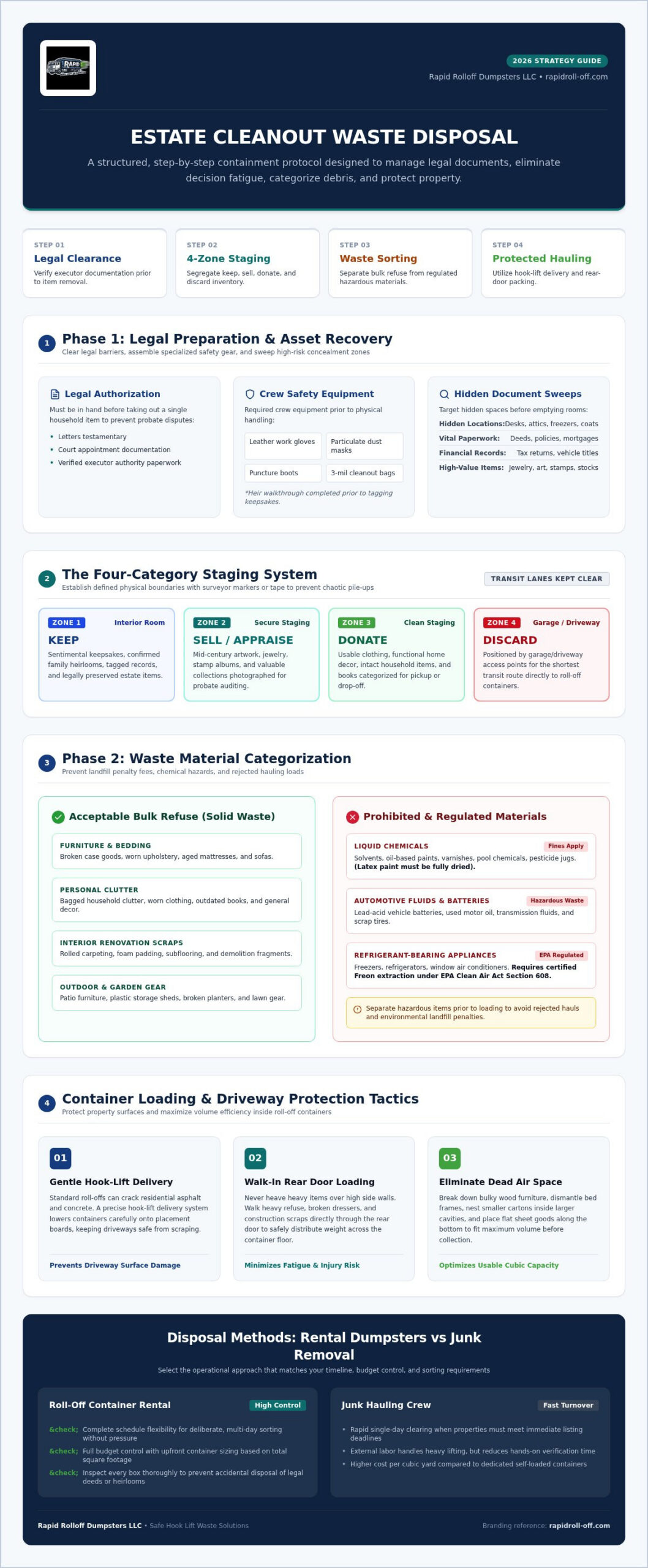
Avoid chaotic pile-ups by mapping out four dedicated physical zones: Keep, Sell/Appraise, Donate, and Discard. Use color-coded painter’s tape or brightly colored surveyor markers on the floor to define boundaries clearly. Keep interior transit lanes and central hallways completely clear to prevent trips and falls while hauling heavy furniture.
Position the discard staging area in the garage or alongside the driveway access points. This creates the shortest transit route possible when transferring heavy refuse into an outdoor container. Understanding standard roll-off container dimensions and capacity helps you calculate staging volumes accurately. This physical separation ensures non-waste items never get mixed into debris intended for disposal, keeping your workflow safe and organized.
Phase 2 Checklist: Categorizing Estate Debris and Prohibited Waste
Tossing every remnant into one massive pile quickly leads to rejected hauls and landfill penalty fees. Efficient estate cleanout waste disposal requires separating inert solid refuse from hazardous or restricted items before loading begins. While the previous phase concentrated on organizing essential estate records and legal documents, this stage prevents dangerous chemical reactions, environmental fines, and wasted hauling runs.
Acceptable Bulk Refuse for Waste Containers
Most general household cleanout debris falls under standard municipal solid waste. You can safely discard these non-hazardous household items in a single container:
- Broken case goods, worn upholstery, sofas, and aged mattresses
- Bagged personal clutter, clothing, outdated books, and general home decor
- Interior renovation scraps, rolled carpeting, foam padding, and subflooring
- Outdoor patio furniture, plastic storage sheds, broken planters, and lawn gear
Partnering with Rapid Rolloff Dumpsters LLC allows you to clear these high-volume items quickly while keeping your driveway safe from unnecessary equipment damage.
Regulated and Prohibited Materials Checklist
Environmental protection laws and landfill rules prohibit several common estate items from entering general disposal containers. Never toss these restricted materials into regular bins:
- Liquid chemicals: Solvents, oil-based paints, varnishes, pool chemicals, and pesticide jugs. Latex paint must be fully dried before standard trash collection.
- Automotive fluids and batteries: Lead-acid vehicle batteries, used motor oil, transmission fluids, and scrap tires.
- Refrigerant-bearing units: Freezers, refrigerators, and window air conditioners require certified Freon extraction under EPA Clean Air Act Section 608 before transport.
- E-waste and pharmaceuticals: CRT monitors, flat-screen televisions, prescription medications, and medical sharps.
Set aside a dedicated garage corner for these items. Residents across Jefferson County and Orange County can coordinate safe drop-offs during scheduled local household hazardous waste collection events or utilize approved municipal drop-off facilities.
Comparing Estate Cleanout Disposal Methods: Roll-Offs vs. Junk Haulers
Selecting the right debris removal service shapes your entire project timeline. Your choice hinges on debris volume, physical capability, and how much time you have to sort through personal items. While some executors want immediate clearance, others need several days to verify paperwork and inspect family heirlooms before tossing anything into an estate cleanout waste disposal bin.
When to Hire Full-Service Junk Removal Crews
Labor-inclusive junk hauling works best when speed outweighs thorough sorting. If an out-of-town executor must empty a small condominium within a single afternoon, paying for two workers and a box truck makes practical sense. It also helps if family members cannot perform heavy lifting due to physical limitations.
The clear drawback is forced decision-making. Junk haulers charge by the fractional truckload, and the crew waits while you decide. Rushing to point at items under a ticking clock often causes regret, particularly when sentimental items get discarded by accident. For large properties packed with decades of goods, multiple truckload runs can escalate disposal costs quickly compared to renting stationary containers.
When to Rent an On-Site Waste Container
Whole-home liquidations, full garages, and multi-structure properties benefit far more from an on-site container. Having a bin stationed in the driveway gives family members the space to review items methodically, set aside keepsakes, and comply with household hazardous waste regulations at a comfortable pace.
Choosing a stationary bin gives you total control over the cleanup schedule. Rather than staging messy piles on lawns or porches while waiting for an appointment, you can carry debris straight outside. Look at how Rapid Rolloff Dumpsters simplifies extended estate cleanout timelines with dependable delivery and pickup schedules. Hook-lift container delivery provides ground-level walk-in entry, while gentle hydraulic placement keeps residential driveways protected from scrapes and surface damage during long sorting projects.
Choosing the Right Dumpster Size and Placement for Estate Projects
Selecting the proper container size keeps your estate cleanout waste disposal moving without mid-project interruptions. Underestimating trash volume leads to frustrating pauses while waiting for a haul-and-return cycle. Conversely, picking an unnecessarily massive bin occupies critical driveway room needed for family vehicles and donation vans.
Matching Cleanout Volume to Container Capacity
Cleanout demands vary widely based on property size, lifestyle habits, and storage density. Match your scope directly to verified container capacities:
- 20-Yard Hook Lift Dumpster: Fits two-bedroom residential cleanouts, attached garages, townhouses, or cleared attics. This size handles roughly 110 to 130 standard contractor trash bags, making it the most frequent residential choice.
- 30-Yard Dumpster: Designed for four-bedroom homesteads with bulky furniture suites, basement decluttering, and light structural renovation debris.
- 40-Yard Hook Lift Dumpster: The heavy-duty solution built for extensive multi-structure estate clearances, large outbuildings, or severe hoarding situations requiring immense cubic capacity.
Aligning container dimensions with your room count prevents container overflow and keeps your cleanout within legal transport limits. For projects involving dense construction debris, the demolition waste container sizing and disposal guide explains how to balance container volume with legal weight limits.
Driveway Protection and Site Delivery Planning
Traditional roll-off trucks use winches and steel cables to pull heavy bins off their beds, creating severe dragging friction that can gouge residential concrete or asphalt. Hook-lift trucks, however, use hydraulic lifting arms to lower the container straight down with pinpoint precision. This gentle placement mechanism protects residential surfaces, even in confined driveways where maneuvering room is limited.
Before delivery, prepare your drop site thoroughly:
- Inspect overhead space, maintaining at least ten feet of clearance away from low tree branches, service drops, and electrical lines.
- Ensure the delivery path provides a clear, straight entry without blind curves or blocked driveway approaches.
- Lay heavy plywood sheets on the surface to distribute the resting weight evenly across concrete pads.
- Verify municipal parking rules if local street space must be utilized in neighborhoods throughout Groves, Nederland, Port Neches, and Beaumont.
Planning these access logistics ahead of time guarantees an uncomplicated delivery. For reliable local drop-offs and residential-safe placement, rent a roll-off container from Rapid Rolloff Dumpsters to keep your cleanout on track.
Phase 3 Checklist: Efficient Dumpster Loading and Project Wrap-Up
Loading your container properly saves both space and money. Efficient packing prevents accidental void pockets that waste usable capacity, ensuring you get every bit of value from your rental. A structured loading process also keeps the cleanout safe, preventing heavy shifts or tipping hazards during transport.
Strategic Space-Saving Loading Techniques
Start by unlatching the rear swing door. Walking heavy goods directly onto the container floor saves your back and prevents shoulder injuries caused by tossing bulky furniture over high sidewalls. Follow these structural packing techniques:
- Lay broad flat items like worn mattresses, table leaves, and headboards flush along the bottom floor or upright against side panels.
- Break down particle-board desks, hollow bookcases, and wooden dining tables using a mallet or pry bar to collapse large, empty frame shapes.
- Distribute heavy solid items uniformly across the width and length to keep the bin balanced for the truck hoist.
- Pack contractor trash bags, rolled carpets, pillows, and clothing bundles into open gaps between rigid wooden furniture.
Keep your refuse level with the top rim of the container. Haulers cannot legally cover or haul overloaded bins under highway transit safety laws, and overfilled debris will require manual repacking before departure.
Final Property Inspection and Pickup Scheduling
Once the house is cleared, shift your attention to wrapping up the site safely. Run a rolling magnetic sweep across driveway pavers, garage thresholds, and turf borders to pick up fallen construction staples, rusty tacks, and nails. Gather charity drop-off vouchers, salvage receipts, and signed estate settlement paperwork into your records binder for final estate accounting.
Secure the rear container doors tightly. Ensure the heavy-duty latch is locked into position and that no tree branches, vehicles, or loose trash block the truck’s driveway access. Finally, call Rapid Rolloff Dumpsters to schedule fast, reliable container pickup in Southeast Texas. Their team handles the final haul quickly, allowing you to hand over a clean, empty home ready for market on schedule.
Streamline Your Project and Protect Your Property
A successful transition comes down to steady preparation, separating restricted items early, and loading methodically. Following a structured system removes logistical guesswork and prevents decision fatigue, allowing you to focus on family priorities. Managing your estate cleanout waste disposal doesn’t have to feel overwhelming when you have the right container ready in the driveway.
Rapid Rolloff Dumpsters makes residential cleanouts simple and stress-free. Locally operated in Groves, Texas, our dedicated dispatch serves families throughout Jefferson and Orange Counties. We provide dependable 20-yard and 40-yard hook lift dumpsters alongside 30-yard containers, matching any project scale. Our specialized hook-lift trucks lower bins gently to the surface, keeping your driveway safe from scrapes and structural cracks.
Take the stress out of property clearance. Order a Driveway-Safe Estate Cleanout Dumpster Today to keep your project moving smoothly and hand over a clean home right on schedule.
Frequently Asked Questions
How long does it typically take to complete an estate cleanout waste disposal project?
Most whole-home projects require three to seven days of active sorting and loading. Small condos or pre-sorted homes can wrap up in a single weekend. Multi-decade family properties or estates with packed workshops and attics often take closer to two full weeks. Having a stationary container in the driveway prevents delays by letting you clear rooms continuously without waiting on scheduled pickup slots.
What size dumpster is most commonly rented for an estate cleanout?
A 20-yard hook lift dumpster is the most frequent choice for standard residential properties. It holds roughly 110 to 130 contractor trash bags, providing enough room for furniture sets, boxed items, and garage clutter from a typical two-bedroom house. Larger multi-story homes or properties with full detached sheds generally require a 30-yard dumpster or a 40-yard hook lift dumpster to avoid overfilling.
Can I throw old appliances and electronics into an estate cleanout dumpster?
Standard metal scrap and dry small appliances are acceptable, but units containing Freon are strictly banned until certified technicians evacuate the refrigerant. Refrigerators, freezers, and air conditioners cannot enter the waste container without written proof of recovery under federal clean air standards. Consumer electronics like televisions and computer monitors also face landfill bans in Texas and require separate electronic waste recycling drop-offs.
How do hook lift dumpsters protect residential driveways during cleanouts?
Hook-lift trucks use hydraulic mechanical arms that lift and gently set containers directly into place. Traditional roll-off trucks pull containers off the rail bed using heavy steel cables and winches, which drags the steel wheels across the ground. The precise vertical motion of a hook-lift system eliminates dragging friction, preventing asphalt gouging and cracked concrete across residential driveways in Groves and Beaumont.
What items are strictly prohibited from estate cleanout dumpsters?
Liquid chemicals, vehicle components, and hazardous compounds cannot enter standard disposal containers. Never load motor oil, gasoline, car batteries, wet oil-based paint, pesticides, or propane tanks into your estate cleanout waste disposal bin. Local environmental ordinances across Jefferson and Orange Counties mandate that residents bring these dangerous substances to municipal household hazardous waste collection facilities for safe chemical processing.
How should I handle items that are too good for the landfill during an estate cleanout?
Stage reusable furniture, kitchen sets, clothing, and boxed books in an isolated indoor area before ordering your waste container. Invite estate liquidators to review high-value items first, or host a dedicated tag sale on the property. Afterward, schedule pickups with local charitable thrift organizations across Nederland and Port Arthur for remaining functional goods, reserving container space exclusively for damaged, unwearable, or broken trash.
Do I need a municipal permit to keep a cleanout dumpster on my driveway?
Placing an estate container fully on a private residential driveway requires no municipal street permit. If limited space or steep grades force placement onto public streets, curbs, or thoroughfares, local city codes require a right-of-way permit before drop-off. Homeowner associations may also enforce private placement rules, so check neighborhood bylaws in Port Neches or Bridge City before scheduling container delivery.