The biggest, heaviest truck isn’t always the best tool for your home renovation. In fact, choosing the wrong delivery system can turn a simple cleanup into a costly driveway repair. You likely expect a straightforward delivery, but the mechanical differences in a hook lift vs roll off dumpster can be the deciding factor between a successful project and an expensive headache.
It’s frustrating to worry about cracked concrete or a container that blocks your entire garage because a truck couldn’t maneuver into your narrow cul-de-sac. We understand that you need an efficient waste solution that respects your property and your time. This article breaks down the critical differences between these two systems so you can choose the safest, most efficient rental for your specific site. We will explore how each mechanism works, the space requirements for delivery, and which option helps you avoid the unexpected fees that often come with failed drop-offs or overweight loads.
Key Takeaways
- Understand how different loading mechanisms impact your driveway’s safety and the delivery’s speed.
- Identify why hook lift systems are better for tight residential spaces where traditional trucks can’t maneuver.
- Evaluate the hook lift vs roll off dumpster based on your specific waste type and the total weight of your debris.
- Learn the exact measurements you’ll need to prepare your site and avoid common delivery setbacks.
- Discover how local logistical knowledge ensures your project stays on schedule without damaging your property.
Understanding the Mechanics: Hook Lift vs. Roll Off Systems
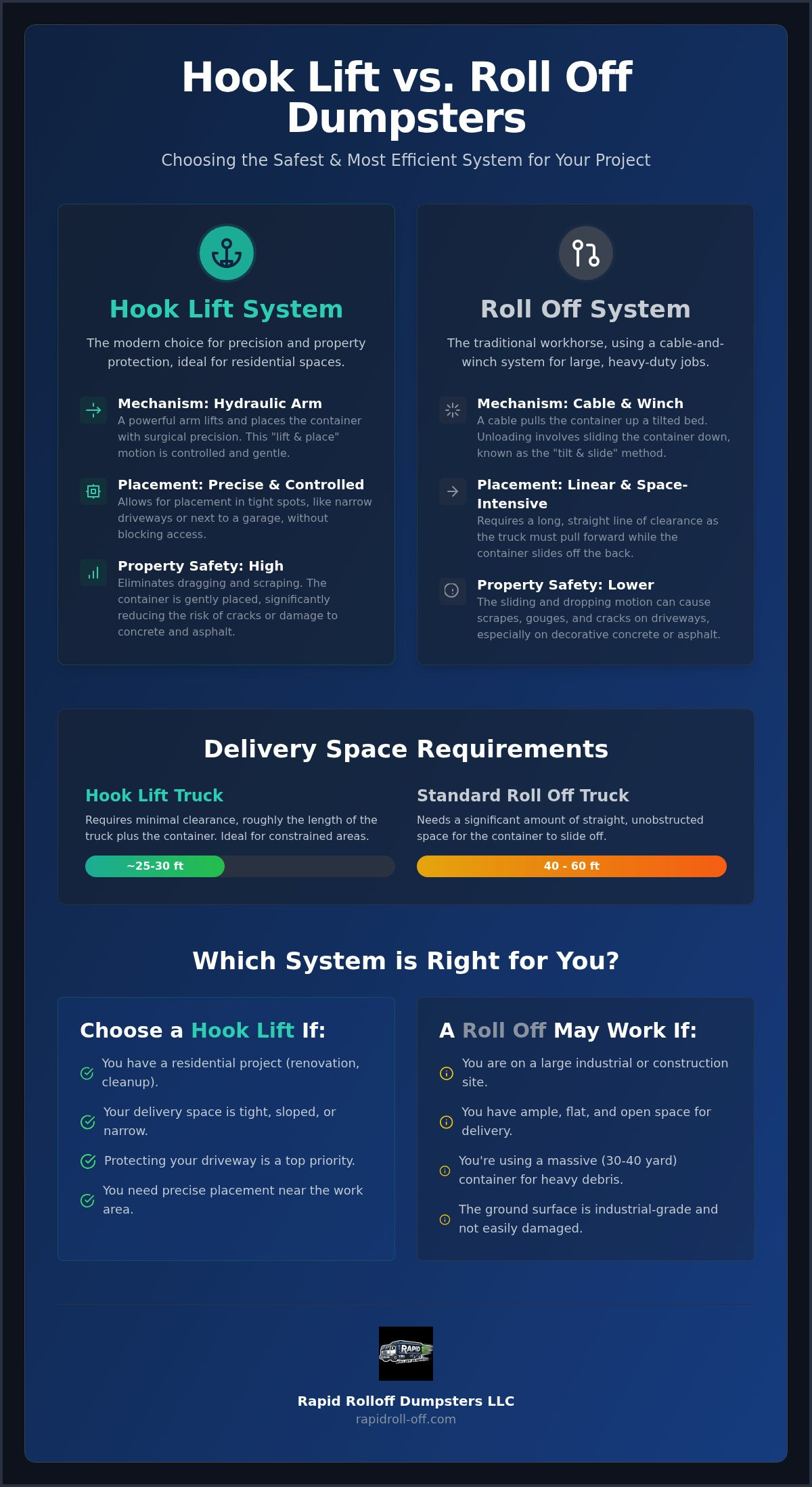
Choosing between a hook lift vs roll off dumpster starts with how the truck moves the heavy steel container. While both systems deliver a bin to your property, they use different mechanical forces to get the job done. The roll-off system relies on a vintage cable-and-winch design. In contrast, the hook lift utilizes a powerful hydraulic arm to grab and maneuver the container. These mechanical differences determine how much space you need and how much stress your driveway will endure during delivery.
How the Traditional Roll-Off Cable System Works
Standard roll-off trucks use a heavy-duty winch and a steel cable to pull the dumpster onto the truck’s bed. To unload, the driver tilts the bed and slowly lets the cable out. This causes the bin to slide down the rails until the rear wheels hit the ground. Because the bin must slide off the back, the truck needs a significant amount of horizontal space, often 40 to 60 feet, to complete the delivery. This process can be jarring. If the cable isn’t perfectly tensioned, the bin might drop the last few inches with a “slam” that vibrates through the concrete.
The Modern Hook Lift Advantage
The Hydraulic hooklift hoist system offers a more surgical approach. Instead of a cable, a massive hydraulic arm reaches out, hooks the container, and lifts it into the air. The driver then places the bin exactly where it needs to go. This “lift and place” motion is much gentler on your driveway than the “tilt and slide” method used by cable trucks. It’s the primary reason hook lifts are becoming the preferred choice for residential neighborhoods in Southeast Texas. This system allows for precision placement in tight alleys or narrow driveways where a cable truck simply couldn’t maneuver.
You might wonder why cable systems remain so common if hook lifts are more precise. Historically, North American waste management has defaulted to cable systems because they were the first to be mass-produced. They are also incredibly strong for hauling the massive 30-yard and 40-yard containers used on industrial job sites. However, for the average homeowner comparing a hook lift vs roll off dumpster, the mechanical precision of the hook lift often outweighs the brute strength of the cable. It offers a level of control that protects your property from the sliding and scraping inherent in older delivery methods.
Key Advantages of Hook Lift Dumpsters for Residential Projects
Hook lift systems are the residential specialists of the waste industry. Their design prioritizes control and safety over the raw hauling capacity of industrial rigs. Comparing a hook lift vs roll off dumpster for a home project reveals why precision matters more than power. This level of control is especially valuable in Southeast Texas neighborhoods where driveways are narrow and streets are lined with parked cars.
Precision Placement in Tight Spaces
A primary benefit of the hook lift is its small footprint. Traditional cable trucks need up to 60 feet of straight-line clearance to slide a bin onto the ground. Because the hook lift truck uses a hydraulic arm to lift the container vertically, it requires much less “swing room.” Drivers can place a 20-yard bin in a spot barely larger than the container itself. This allows you to tuck the dumpster into a narrow alley or right next to your garage without blocking your entire driveway. It’s a surgical approach to waste removal. Adhering to OSHA safety standards for container handling is easier when the driver has total control over the hydraulic arm. This precision prevents accidental damage to fences, overhangs, or vehicles parked nearby.
Protecting Your Property and Concrete
Traditional roll-off delivery involves a “dragging” motion. As the bin slides off the rails, the steel wheels can scar asphalt or scrape the finish off decorative concrete. Hook lift trucks eliminate this risk by placing the bin down with a gentle, vertical motion. The weight is distributed more evenly during the transition from the truck to the ground. This significantly reduces the chance of your driveway cracking under the sudden pressure of a dropping load. We specialize in these “driveway-safe” methods to give homeowners peace of mind. Our fleet focuses on 20-yard and 40-yard hook lift rentals specifically because they offer the best protection for residential surfaces. Consider our 20-yard hook lift dumpster rental for your next home renovation to ensure your property remains in pristine condition.
Visibility also plays a major role in residential safety. Hook lift drivers often have a better line of sight because they aren’t relying solely on mirrors and cable tension. They can see exactly where the hook meets the bin. This leads to faster, safer deliveries in busy cul-de-sacs where children or pets might be present. It makes the entire process stress-free for you and your neighbors.
When to Choose a Standard Roll-Off Dumpster
While hook lifts offer surgical precision for residential driveways, the traditional roll-off system remains the industry workhorse for a reason. There are specific scenarios where the mechanical design of a cable-and-winch system is actually the better tool for the job. Understanding the trade-offs in the hook lift vs roll off dumpster debate ensures you don’t end up with a delivery delay or a container that can’t be safely placed due to overhead obstructions.
The 30-Yard Construction Workhorse
For large-scale construction and major demolition, volume and weight capacity are the primary concerns. Our 30-yard dumpster rental utilizes the traditional roll-off system because it’s exceptionally reliable for heavy, dense materials. When you’re disposing of old shingles, masonry, or concrete debris from a commercial site, the cable system provides the brute strength needed to haul several tons of waste safely. Most large-scale job sites have the 60 feet of linear space required for a cable truck to operate. On these sites, following waste material disposal regulations is a top priority. The standard roll-off is the go-to choice for contractors who need a reliable, cost-effective way to manage massive amounts of debris without the need for specialized residential placement.
Navigating Overhead Obstructions
One counterintuitive advantage of the roll-off system is its lower vertical profile during delivery. While a hook lift uses a hydraulic arm that reaches high into the air, a roll-off truck simply tilts its bed. In older neighborhoods across Nederland and Port Arthur, low-hanging power lines and thick oak tree canopies are common. If your delivery site has a significant “ceiling” of wires or branches, a hook lift arm might reach too high and cause a safety hazard. In these cases, the tilting motion of a cable truck is safer. It keeps the container closer to the ground during the entire “slide” process. Choosing the right tool depends on your specific Southeast Texas skyline. If your property has limited vertical clearance but plenty of horizontal driveway space, the 30-yard roll-off is often the most practical and safest option for your project.
Ultimately, the choice depends on your project’s scale and your site’s physical limits. We provide both options to ensure you get the most efficient service possible. If you’re managing a major demolition or a heavy roofing job, the capacity and lower delivery arc of a standard roll-off bin provide the reliability you need to keep the job moving.
Site Preparation and Selection Criteria: Making the Final Call
Once you understand the mechanical differences in a hook lift vs roll off dumpster, you must evaluate your actual job site. A perfect dumpster choice fails if the delivery truck cannot reach the drop-off point. Proper preparation prevents failed delivery fees and ensures your project starts on schedule. Before you book your rental, take a few minutes to walk your property and identify potential obstacles.
Measuring for Success
Precision requires planning. While hook lifts are more maneuverable, they still need adequate space to operate safely. Follow the “10-foot rule” by ensuring there is at least 10 feet of clear space around the entire perimeter of the container’s final location. This space allows you to walk around the bin and load debris from all sides without tripping. You must also check your vertical clearance. Look up for low-hanging eaves, power lines, and tree branches that could snag the truck’s rails or hydraulic arm.
Horizontal space is equally important. You must account for swing room during the delivery process. Swing room is the space needed for the truck to maneuver, turn, and back the container into its final position. If you live on a narrow residential street in Groves or a tight cul-de-sac in Beaumont, a hook lift system is often the only way to navigate these tight turns. Always communicate the exact width of your driveway to your provider so they can send the right equipment for the job.
Local Environmental Factors in SE Texas
The climate in Southeast Texas presents unique challenges for heavy equipment. In Port Arthur and Beaumont, high humidity and frequent rain cycles often lead to soft ground. A fully loaded 20-yard or 40-yard bin can weigh several tons. If placed on soft soil or grass during a wet week, the container may sink or become stuck. We recommend placing the dumpster on a hard, level surface like concrete or stabilized gravel whenever possible.
The Texas heat also affects your driveway. Asphalt can soften when temperatures exceed 90 degrees, making it susceptible to scarring from heavy steel wheels. If you are concerned about your driveway’s finish, ask your provider about using protective boards under the bin’s contact points. Additionally, be aware of local regulations. If you plan to place your dumpster on a public street in Bridge City or Orange, you may need a Right-of-Way permit from the city. Checking these details early prevents legal headaches and ensures a smooth pickup. To get started with a local team that understands these regional challenges, rent a driveway-safe dumpster from our specialized fleet today.
Why Rapid Rolloff is the Trusted Choice in Southeast Texas
We aren’t just another waste company operating from a remote call center. We are a locally owned business that understands the specific logistics of Groves, Beaumont, and Nederland. Our team lives and works in these communities. We know the tight residential streets and the demanding requirements of local construction sites. This local perspective allows us to offer more than just a bin; we provide a tailored waste solution that respects your property and your project timeline.
A Fleet Designed for Your Needs
Our specialized fleet is built to handle the diverse needs of Southeast Texas. We offer 20-yard and 40-yard hook lift rentals specifically for residential projects where driveway safety and precision are the top priorities. These containers are ideal for home cleanouts and renovations because they utilize the gentle “lift and place” method. For larger demolition or commercial projects, our 30-yard dumpster rental provides the heavy-duty capacity required for bulk debris. By maintaining both systems, we ensure you never have to compromise on the hook lift vs roll off dumpster choice. Every truck and container in our fleet undergoes regular maintenance to guarantee reliable performance on your site.
The Local Advantage Over National Chains
National waste chains often struggle with the nuances of local Southeast Texas logistics. They might use automated dispatchers who don’t understand the narrow alleys of Port Arthur or the specific permit requirements in Bridge City. When you work with us, you speak directly to the people who deliver your bin. This direct communication eliminates the risk of “failed delivery” fees caused by a driver who isn’t prepared for your site’s physical limits. We also prioritize transparent pricing. You won’t find hidden “national chain” surcharges or unexpected environmental fees on your bill. We believe in fair, upfront costs that reflect our commitment to the community.
Reliability is the foundation of our service. We understand that a delayed dumpster can stall an entire construction crew or ruin a weekend renovation plan. Our drivers pride themselves on punctual deliveries and pickups. We treat your property with the same care we would our own, ensuring a stress-free experience from start to finish. Get a stress-free quote for your Groves dumpster rental today!
Choose the Right Tool for Your Project Success
Selecting the right container starts with evaluating your site’s physical limits and your project’s waste volume. The choice of a hook lift vs roll off dumpster determines how much space the truck needs for delivery and how much protection your driveway receives. Hook lift systems offer surgical precision for home renovations, while standard roll-offs provide the brute strength needed for high-capacity construction jobs.
As a locally owned and operated business in Groves, TX, we focus on providing “driveway-safe” solutions across the entire region. Our specialized fleet handles the narrow streets of Port Arthur and the residential cul-de-sacs of Beaumont with ease. We eliminate the stress of failed deliveries and hidden fees by prioritizing direct communication and local expertise. Book your driveway-safe dumpster rental with Rapid Rolloff today!
You deserve a waste removal partner that values your property as much as you do. Let’s get your project moving forward with the right equipment and a team that cares about your success. We are ready to help you clear the clutter without the headache.
Frequently Asked Questions
Is a hook lift dumpster safer for my driveway than a roll-off?
Yes, a hook lift dumpster is generally safer for residential driveways. This system uses a hydraulic arm to lift the container vertically rather than sliding it off the back of a truck bed. This eliminates the dragging motion that often causes scratches or cracks in concrete and asphalt. It’s the preferred choice for homeowners in Groves who want to protect their property during a renovation.
What is the maximum weight limit for a 20-yard hook lift dumpster?
A 20-yard hook lift dumpster typically has a weight limit between 3 and 5 tons. While the container can hold a significant amount of waste, exceeding these limits can lead to overage fees or delivery failures. If you’re disposing of heavy materials like shingles or masonry, it’s vital to discuss the total weight with our team before your delivery in Port Arthur to ensure we match the right truck to your load.
Do I need to be home for the delivery of my dumpster in Beaumont?
You don’t necessarily need to be home for your dumpster delivery in Beaumont as long as the drop-off area is clear. We recommend providing specific instructions or marking the placement spot with cones or chalk. Ensure there are no parked cars or low-hanging obstructions in the way. Our drivers will confirm the placement and ensure the bin is positioned safely for your project without requiring your physical presence.
Can a hook lift truck deliver a dumpster in a narrow alley?
Yes, hook lift trucks are specifically designed for tight spaces and narrow alleys. Because they don’t require the same long horizontal slide room as a cable truck, they can maneuver into spots that traditional roll-offs can’t reach. This makes them ideal for older neighborhoods in Nederland where space is limited and precision is required to avoid blocking traffic or damaging nearby structures during the drop-off.
What happens if the dumpster is too heavy for the lift system?
If a container exceeds the weight capacity of the hydraulic arm, the driver won’t be able to lift it onto the truck safely. This situation usually requires you to remove some of the debris before we can complete the pickup. Overfilling also poses a safety risk during transport on local roads. We help you estimate your load weight early to avoid these delays and the potential for unexpected overage fees.
Are there items I cannot put in a hook lift or roll-off dumpster?
You cannot put hazardous materials, chemicals, batteries, or tires in any of our containers. These items are restricted by local landfill regulations in the Orange area and require special disposal methods. Putting prohibited items in your bin can result in significant fines or a refusal of pickup. Always check with us if you’re unsure about specific materials like wet paint, electronics, or large appliances.
How much vertical clearance do I need for a hook lift delivery?
You generally need approximately 15 to 20 feet of vertical clearance for a successful hook lift delivery. The hydraulic arm reaches high into the air during the loading and unloading process. Before we arrive at your site in Bridge City, check for low-hanging power lines, eaves, or tree branches. If your site has a low canopy, the tilting motion of a standard roll-off might be the safer mechanical choice.
Which system is better for roofing shingle disposal?
The best system for shingles depends on the scale of your tear-off and the hook lift vs roll off dumpster comparison for your specific site. For smaller residential jobs, a 20-yard hook lift provides excellent driveway protection. However, because shingles are incredibly dense, a 30-yard dumpster rental is often the workhorse for larger commercial roofs. We offer both options to ensure you have the right weight capacity for your specific roofing debris.