
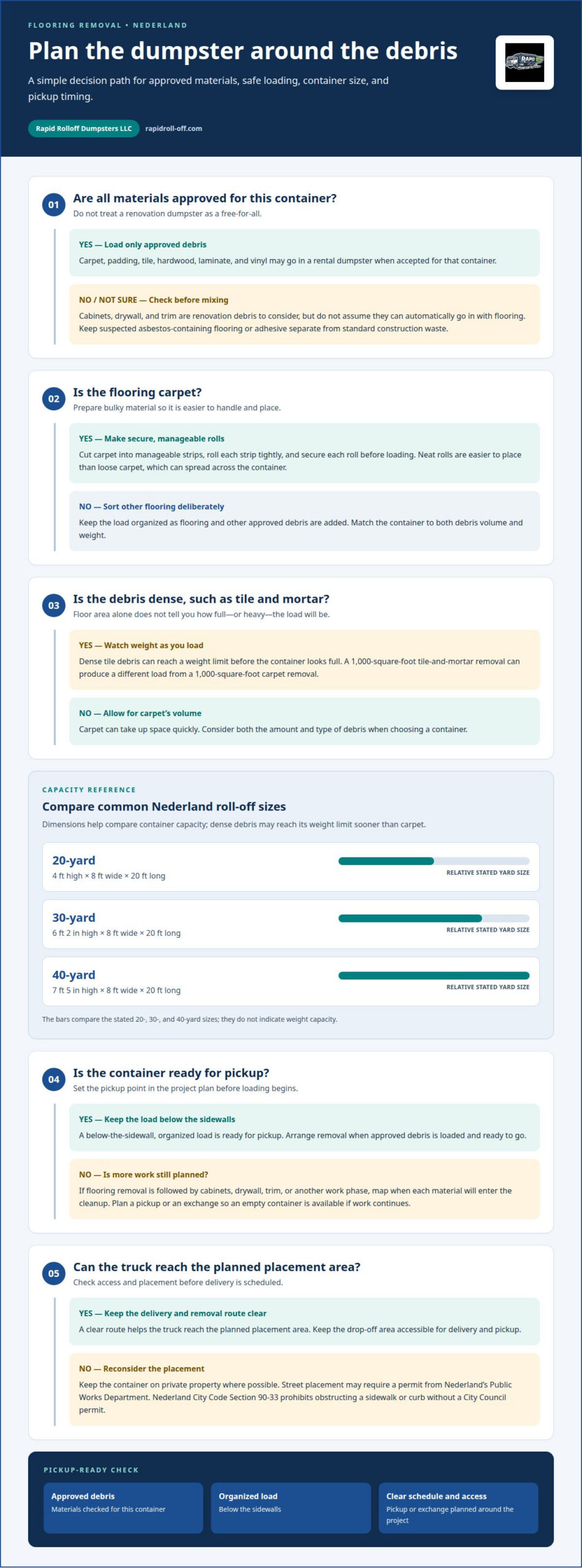
A renovation dumpster isn’t a free-for-all: a flooring removal dumpster in Nederland can take flooring and other debris together only when the materials are approved for that container. Keep the load below the sidewalls for pickup, and don’t assume cabinets, drywall, or trim can automatically go in with flooring.
A renovation cleanup is easier to manage with a clear plan, especially when flooring is only part of the debris. Prepare carpet for loading, consider which materials can share a container, and coordinate delivery and pickup with the project schedule.
When choosing a container for residential or commercial work, consider both the type and amount of debris. Dense tile can reach a weight limit before the container looks full, while carpet can take up space quickly. Plan the cleanup around these differences to keep debris organized as work progresses.
Key Takeaways
- Cut carpet into manageable strips, roll it tightly, and secure it before loading to make handling easier.
- Match container size to the material: dense tile and mortar can take up space differently from carpet.
- Plan pickup and exchanges around your debris volume, and keep the load below the dumpster’s sidewalls.
- For commercial tear-outs, treat suspected asbestos-containing flooring or adhesive separately from standard renovation debris.
Can carpet and padding go in a roll-off dumpster?
Yes, carpet and padding can go in a roll-off dumpster when accepted as renovation debris. Cut carpet into manageable strips, roll them tightly, and secure each roll. For a flooring removal dumpster in Nederland, choose a container based on both the debris volume and weight.
Common Nederland roll-off sizes include a 20-yard container measuring 4 feet high by 8 feet wide by 20 feet long, a 30-yard container measuring 6 feet 2 inches high by 8 feet wide by 20 feet long, and a 40-yard container measuring 7 feet 5 inches high by 8 feet wide by 20 feet long. Those dimensions help compare capacity, but dense tile debris can reach a weight limit sooner than carpet.
Accepted Flooring and Heavy Debris
Carpet, tile, hardwood, laminate, and vinyl may go in a rental dumpster when approved for that container. Cabinets, drywall, and trim are also renovation debris to consider, but don’t assume every material can be mixed. A flooring removal dumpster in Nederland should hold only approved debris. Keep suspected asbestos-containing flooring or adhesive separate from standard construction waste.
Nederland demolition rules also assign disposal responsibility. A contractor hired to demolish or remodel a building is responsible for disposing of all material. Nederland City Code Section 86-36(a) places responsibility for brick, broken concrete, lumber, plaster, sand, and gravel on the owner or person controlling the material, at their own expense.
Preparing Flooring for Pickup
Prepare carpet by cutting it into manageable strips, rolling each strip tightly, and securing it before loading. Neat rolls are easier to place than loose carpet, which can spread across the container. For a flooring removal dumpster in Nederland, keep the load organized and below the sidewalls for pickup.
Consider material as well as floor area when planning capacity. A 1,000-square-foot carpet removal can produce a different dumpster load from a 1,000-square-foot tile-and-mortar removal. Sort dense tile and mortar deliberately, since a container may become heavy before it appears full.
Pickup and exchange scheduling
Plan delivery around the renovation sequence, not just the day flooring comes up. If cabinets, drywall, or trim are removed afterward, map when each material will enter the cleanup. For a flooring removal dumpster in Nederland, arrange pickup when the approved debris is loaded and ready to go. Keep the drop-off area clear so the delivery truck can reach it.
Decide on a pickup point in the project plan before loading begins. Keep debris below the sidewalls, then arrange removal when the container is ready. If work continues, plan for an exchange so an empty container is available for the next phase. For a flooring removal dumpster in Nederland, this can help prevent debris from piling up as crews move between rooms or work areas.
Weekly garbage service often won’t collect bulk flooring debris all at once. Curbside bulk pickup rules vary by trash company and may limit construction debris or the amount collected. Nederland allows a one-time City pickup of 4 cubic yards when an owner tears down a building. Nederland City Code Section 86-30 gives the City exclusive rights to collect household refuse inside city limits, so curbside household refuse and renovation debris aren’t interchangeable disposal plans.
Keep the container on private property where possible. Nederland City Code Section 90-33 prohibits obstructing a sidewalk or curb without a City Council permit. For a flooring removal dumpster in Nederland, street placement can affect delivery and pickup access. Leave the truck route clear and avoid blocking sidewalks during renovation or moving work.
Before scheduling, map the project stages: flooring removal, other demolition, and final cleanup. This helps determine whether one pickup suits the work or an exchange fits the next debris phase. If a roll-off rental fits your renovation plan, explore roll-off dumpster rental options as you arrange the schedule.
Roll-off dumpsters for renovation and demolition
Plan roll-off placement before renovation debris starts moving out of the building. In Nederland, truck access and the placement surface can affect delivery and pickup.
Roll-Off Placement and Truck Access
Measure the driveway and the truck’s approach before scheduling delivery. A Nederland roll-off delivery requires a truck approach of 60 feet or more and 21 feet of overhead clearance. Delivery also requires 23 feet of vertical clearance. Keep the path clear of parked vehicles, branches, and other obstructions so the truck can reach the planned placement area.
Choose a firm, accessible spot near the demolition work, with room for the truck to maneuver. A container placed on a street may require a permit from Nederland’s Public Works Department. Account for the permit before setting the delivery date.
Temporary Dumpster Placement
A temporary roll-off can collect construction debris during a renovation or demolition and leave once the waste is ready for pickup. Decide whether the driveway or another private area can hold it without blocking workers, household access, or material deliveries. Keep the truck route open for both delivery and removal.
Street placement involves different considerations from a driveway. Nederland City Code Section 90-33 prohibits obstructing a sidewalk or curb without a City Council permit. Keep the container clear of pedestrian access and avoid placing debris around it, where it could narrow the walkway.
For a rental in Nederland, match the container size and approved debris to the demolition plan. Coordinate delivery, pickup, and any exchange needed if work continues after the container fills. Map the sequence from flooring removal to cabinet, drywall, or trim demolition. This helps coordinate the container with each phase and avoid interrupting crews.
Companies serving Nederland offer different rental arrangements, so the useful terms are the container type, accepted materials, placement, and pickup or exchange process. For public-street placement, include the possible Public Works permit in the plan. For a driveway, verify the approach and clearance measurements before delivery; overhead clearance ranges from 21 feet at the truck approach to 23 feet vertically for delivery.
Commercial flooring removal
Commercial flooring tear-outs need a debris plan that accounts for material, weight, and work sequence. Larger commercial flooring removal projects or tile installations may take an entire day, so contractors can coordinate removal and cleanup in stages rather than letting debris build up across active work areas.
Start by identifying each flooring material, including its backing or adhesive. Carpet, tile, and other flooring can create very different loads, even across the same floor area. Dense tile and mortar add weight quickly, while rolled carpet takes up more container space. Separate flooring debris from cabinets, drywall, and trim when the project requires distinct disposal or recycling handling.
Pay close attention to older linoleum. Some linoleum may be attached with asbestos-based glue or mastic, which cannot be recycled. Suspected asbestos-containing flooring, backing, or adhesive should not go into a standard construction dumpster. Keep it separate from ordinary renovation debris and arrange appropriate asbestos handling.
For a commercial remodel, use this sequence:
- Identify flooring, backing, and adhesive before demolition starts.
- Separate suspected asbestos-containing materials from standard debris.
- Estimate the amount of dense tile, mortar, and lighter flooring separately.
- Plan container loading around the work phases and the cleanup area.
This approach clarifies which materials can share a container and which need separate handling. The same floor area can produce different debris volumes depending on whether crews remove carpet or tile and mortar. Keep the work zone organized, and don’t mix suspected hazardous material with ordinary construction waste.
For commercial flooring work in Nederland, match the container plan to the materials and demolition sequence. Arrange a renovation debris container around the cleanup stages so crews can keep flooring removal moving without mixing materials that require separate handling.
Rapid Rolloff Dumpsters: 20 Yard Hook Lift Dumpster Rental
Rapid Rolloff Dumpsters LLC helps residential and commercial projects manage flooring and renovation debris with roll-off rentals. Choose a 20 Yard Hook Lift Dumpster Rental for a project that suits that container, or consider the 40 Yard Hook Lift Dumpster Rental or 30 Yard Dumpster Rental for different debris needs.
For a flooring tear-out, plan around the material as well as the floor area. Carpet, tile, and mortar create different loads, and commercial remodels may also produce cabinets, drywall, or trim. Separate suspected asbestos-containing flooring or adhesive from standard construction debris. Keep approved material below the container’s sidewalls for pickup.
Before arranging a rental, outline the work stages and expected debris types. This gives you a practical starting point for choosing a container and coordinating removal with cleanup. For your Nederland renovation, book online at rapidroll-off.com or call Rapid Rolloff Dumpsters LLC.
Set Up Your Renovation’s Next Step
A flooring removal dumpster in Nederland is one part of a renovation plan. Align debris removal with the work schedule so crews know where materials go as each space is cleared. Before work begins, decide who will manage cleanup, where the container should sit, and how its placement fits the site’s daily activity.
For commercial remodels, coordinate the disposal plan with contractors and building operations. A clear process helps keep work areas usable and separates materials that need different handling. For a home project, choose a container location that preserves household access and the route workers will use to carry debris.
When you’re ready to plan a rental for your renovation, contact Rapid Rolloff Dumpsters to discuss the next step. A practical plan can help your flooring project move forward with less disruption and a cleaner work area.
Frequently Asked Questions
Can I mix flooring debris with cabinets, drywall, and trim?
Yes, combine materials only when all are approved for the rental container. A room remodel, for example, might produce carpet, cabinet panels, drywall pieces, and trim. Keep separate any material requiring special handling, including suspected asbestos-containing flooring or adhesive. Sorting debris by type before loading also helps identify items that shouldn’t go with ordinary renovation waste.
Can broken tile, mortar, and grout go in the same dumpster?
Broken tile, mortar, and grout can share a container when each is approved for disposal there. The main concern is their combined weight: dense demolition debris can reach a container’s limit before it looks full. Keep these materials together only if the rental allows them, and don’t use empty space as a reason to add more heavy debris.
What should I do if old flooring may contain asbestos?
Don’t put suspected asbestos-containing flooring, backing, or adhesive in a standard construction dumpster. Pause removal rather than breaking up or mixing the material with ordinary debris. Keep it separate from carpet, tile, cabinets, and drywall, then arrange appropriate asbestos handling. This is especially important with older linoleum, where glue or mastic may also be suspect.
What size dumpster do I need for flooring removal?
Choose based on both the amount and type of flooring, not floor area alone. Carpet takes up space, while tile and mortar can add substantial weight. For a practical comparison, the 20 Yard Hook Lift Dumpster measures 12 feet long, 7.5 feet wide, and 4 feet high, with a 2-ton weight limit. The 40 Yard Hook Lift Dumpster measures 20 by 7.5 by 8 feet, also with a 2-ton limit.
When I rent a dumpster, what can I throw away?
Use the container for debris approved for that rental, such as flooring from a renovation when accepted. Cabinets, drywall, and trim may also be suitable, but don’t assume every material can be mixed. Keep suspected asbestos-containing materials out of a standard construction container. Before loading, sort debris by type and set aside anything requiring special handling.
Where can a roll-off sit on a Nederland job site?
A driveway or other suitable private area can work if the truck can reach it and the container won’t block daily access. Check the truck approach and overhead clearance, then clear vehicles or branches from the route. A street location may require a permit from Nederland’s Public Works Department. Keep sidewalks and curbs unobstructed unless properly permitted.