
A half-full dumpster can hit its weight limit before a full one does. To work out how to estimate debris weight for a dumpster, calculate the waste itself, not the empty container. Multiply the debris volume in cubic yards by its estimated weight per cubic yard, then divide pounds by 2,000 to convert the result to tons.
It’s easy to focus on how much debris will fit, but material type matters just as much. Concrete, soil and other dense materials can reach a weight limit while plenty of space remains.
This guide shows you how to measure debris volume, use practical weight estimates for common materials, and match your tonnage estimate to a suitable dumpster size. You’ll also learn when excess weight fees may apply and how to account for heavier or unexpected debris.
Key Takeaways
- Estimate debris weight from both its volume and material type; dense waste can reach a weight limit before the dumpster looks full.
- Convert cubic feet to cubic yards by dividing by 27, then multiply by the material’s estimated weight per cubic yard.
- Use project details, such as renovation area or roofing squares, to build a more useful starting estimate.
- Compare your estimated tonnage with the dumpster’s weight allowance, not just its volume, to help avoid excess-weight fees.
- Allow for heavier-than-expected materials when choosing a size, especially for mixed demolition debris.
How much weight does each dumpster size hold?
Dumpster volume tells you how much space debris occupies, while material type determines how quickly its weight allowance is reached. Estimate both before choosing a container, especially for construction debris or wet waste.
-
Identify Material Types and Volume
List each material, then estimate its volume in cubic yards. Construction debris varies widely: general construction debris is estimated at 400-600 pounds per cubic yard, while mixed construction debris can reach 500-1,000 pounds per cubic yard. Concrete is much denser, at 2.00 tons per cubic yard. Measure a pile’s length, width, and height in feet, multiply them, then divide by 27 to calculate cubic yards.
Estimate dense materials separately. Broken concrete takes up less space than bulky lumber, but it can weigh more.
-
Account for Debris Conditions
Consider whether debris is wet, compacted, mixed or aged before estimating its weight. Water adds weight to absorbent materials such as drywall, carpet and household waste, so a dry-material estimate may be too low after rain or water exposure. Compaction changes how much space debris occupies, but doesn’t necessarily reduce its total weight.
Older debris may contain mixed or deteriorated materials that are harder to sort. Estimate each material separately when possible, paying particular attention to heavier or wetter portions instead of treating the load as uniform.
-
Compare Typical Material Weights
Use material examples to spot estimates that seem too low. Drywall weighs 500-750 pounds per cubic yard when dry, and a 4-by-8-foot, half-inch sheet weighs nearly 50 pounds. Household junk ranges from 150-400 pounds per cubic yard. A sofa is about 150 to 200 pounds, while an old refrigerator weighs 250 to 300 pounds.
Shingles and appliances can shift the total. Asphalt shingles are estimated at 2,400-2,600 pounds per cubic yard, so roofing debris can weigh far more than the same volume of light household items.
-
Use a Material Weight Calculator
Enter each material type and its estimated volume into a material weight calculator. Keep separate entries for concrete, drywall, shingles, appliances, and mixed waste, then add the results. If you have measurements in cubic feet, divide by 27 first; one cubic yard equals 27 cubic feet.
Choose the calculator category that best matches the debris. A general “construction waste” option may not accurately reflect a load dominated by concrete or wet drywall. Treat the result as an estimate, and sort materials as accurately as you can.
Compare the final tonnage with typical capacity: a 20-yard dumpster handles 3-4 tons, a 30-yard dumpster 4-5 tons, and a 40-yard dumpster 5-6 tons. Dense debris can reach those limits before filling the available volume.
How is debris weight calculated?
Estimate waste by material and measured area, then compare the total with the container’s weight allowance. Kitchen, bathroom and roofing projects require different calculations.
-
Break Down Project Debris Weights
Start with the renovation area and the materials being removed. Bathroom demolition typically produces 30 to 60 pounds of debris per square foot. Kitchen renovations produce an estimated 60 to 100 pounds per square foot. Multiply the project’s square footage by its matching range to create a starting estimate.
Convert pounds to tons by dividing by 2,000, then account for heavy fixtures or mixed demolition waste separately.
Calculate roofing debris separately from room renovations. Roofing materials, coverage and bundle weights call for a different approach, helping you choose a dumpster based on both volume and weight.
-
Estimate Roofing Debris Weight
Count roofing squares before estimating shingle weight. One roofing square covers 100 square feet. Three bundles of asphalt shingles generally cover one square. Three-tab bundles weigh 60 to 80 pounds each, making a square about 180 to 240 pounds. Multiply the number of squares by that weight range.
Shingle type changes the calculation. Architectural shingles weigh 70 to 80 pounds per bundle. Slate shingles weigh 250 to 350 pounds per bundle. Don’t apply three-tab weights to slate or architectural shingles. Asphalt shingles are also estimated at 2,400-2,600 pounds per cubic yard, a useful comparison when debris volume is known.
Use the shingle type and square count to plan dumpster needs. For architectural shingles, one roofing dumpster is recommended for less than 40 squares, two for 40-60 squares, and three for 60-80 squares. For three-tab shingles, one roofing dumpster is recommended for less than 60 squares. These estimates help match the project’s scale to container capacity.
Include underlayment and other roofing materials in your total. If the combined load exceeds the weight allowance, overage fees may apply. A breakdown by material gives you a more useful estimate than counting shingle bundles alone.
Use your calculated weight and debris volume together when comparing dumpster rental options.
Do I need to include the weight of the dumpster itself in my estimate?
No. Estimate the debris, not the empty container. Compare the debris total with the dumpster’s weight allowance and the truck’s hauling capacity.
- Keep debris weight separate from container weight. The dumpster’s own weight isn’t part of your debris estimate. Calculate the materials you plan to load, such as roofing, furniture or construction waste. The container’s capacity and the truck’s hauling limit are separate constraints on the loaded debris.
- Compare your estimate with the dumpster size. Typical weight allowances are 3-4 tons for a 20-yard dumpster, 4-5 tons for a 30-yard dumpster, and 5-6 tons for a 40-yard dumpster. These figures are useful starting points, not a reason to ignore material density. A load of concrete can reach its weight limit before filling the available volume.
- Check whether the load needs a heavy-debris container. A heavy-debris dumpster is 10 cubic yards and holds up to 10 tons. That example shows why dumpster size alone doesn’t determine how much debris you can load. A smaller container may suit dense material better than a larger container intended for lighter waste. Don’t assume every dumpster of the same volume has the same weight allowance.
- Factor in truck hauling capacity. A single rear axle roll-off truck has a maximum legal hauling capacity of 5 tons of debris. A tandem axle roll-off truck has a maximum legal hauling capacity of 10 tons of debris. The truck limit may be lower than the dumpster’s allowance, so compare both before loading. For instance, a 40-yard dumpster with a 5-6 ton allowance still must travel within the truck’s 5-ton limit when hauled by a single rear axle truck.
- Plan around the lower applicable limit. Treat the dumpster’s weight allowance and the hauling capacity as separate ceilings. The practical load limit is whichever is lower for your setup. This matters with dense materials, mixed construction loads or roofing debris. Underestimating tonnage can leave space in the dumpster while still exceeding its weight allowance, which may lead to an overage during disposal.
Before arranging a dumpster rental, write down your estimated debris weight and the materials involved. This gives you a clearer basis for choosing a container without counting the empty dumpster as project waste.
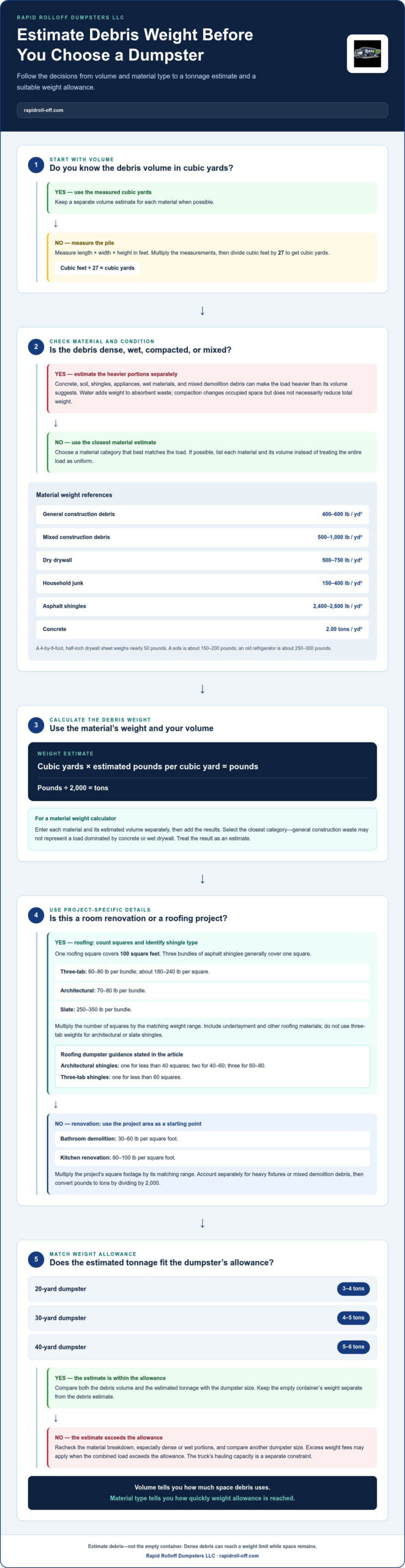
Estimating debris weight for dumpster selection
Choose a dumpster by comparing your estimated debris weight with its volume capacity. Considering both helps reduce the risk of running out of space or exceeding the weight allowance.
- Measure the debris volume. Estimate the pile’s length, width, and height in feet, multiply those measurements, then divide by 27 for cubic yards. For example, a pile measuring 9 feet by 6 feet by 3 feet is 162 cubic feet, or 6 cubic yards. Measure separate piles individually, especially when materials differ.
- Apply the material weight estimate. Multiply cubic yards by the estimated pounds per cubic yard for each material. One ton equals 2,000 pounds. Use the heavier material’s estimate for dense or mixed loads.
- Compare the result with dumpster capacity. Typical guidance recommends a 20-cubic-yard dumpster for debris weighing 2-3 tons and a 30-cubic-yard dumpster for 2-4 tons. A 40-cubic-yard dumpster typically handles 5-6 tons. These ranges help compare rental options, but the material’s density still matters: concrete can reach a weight limit before the container is full by volume.
- Account for the project’s total debris. Use measured material volume rather than house size alone. One estimate example assigns 5 cubic yards per 100 square feet of house area, so a 2,000-square-foot house could produce around 100 cubic yards of demolition debris. That volume estimate does not establish tonnage by itself. Multiply by the relevant material weight to calculate the load.
- Add room for heavier or unexpected waste. Add 10-20% to your tonnage estimate for unexpected waste or heavier materials. Then compare the adjusted total against both volume capacity and weight allowance. If the estimate exceeds either limit, consider a different size or more than one container. Overestimating capacity can help avoid running out of space, delays, and overage fees tied to exceeding the weight limit.
For a practical size comparison, a 20-yard dumpster typically handles 3-4 tons, while a 30-yard dumpster typically handles 4-5 tons. Match the container to your calculated tonnage and cubic yards, not the average debris volume alone.
How can you estimate dumpster debris weight from material type and volume
- Measure the debris pile. Record its length, width, and height in feet. Multiply those measurements to find cubic feet, then divide by 27 to get cubic yards. For example, a pile measuring 9 by 6 by 3 feet holds 162 cubic feet, or 6 cubic yards. Measure separate piles individually when materials differ.
- Match each material to a weight range. Drywall debris weighs an estimated 500-750 pounds per cubic yard. Dry dirt and clean fill weigh 2,000-3,000 pounds per cubic yard. Use the closest material category rather than treating every pile as general waste.
- Calculate each material’s estimated weight. Multiply its cubic yards by the matching pounds-per-cubic-yard range. That equals 1.75-2.1 tons, using 2,000 pounds per ton. Keep low and high estimates until you total the load.
- Separate dense materials from bulky waste. Scrap metal is about 225 pounds per cubic yard. A mixed pile’s average depends on how much of each material it contains. Calculate concrete, soil, or masonry separately, then add lighter materials for a more useful total.
- Review the estimate against container limits. Add the material totals in pounds, then divide by 2,000 for tons. Compare that figure with the dumpster’s weight allowance and compare cubic yards with its volume capacity. A dense load can exceed its weight allowance while leaving open space. If you use a material calculator, enter each material separately and select the closest category; the estimate is only as useful as those inputs.
Carpet weighs 0.5 pounds to 2.2 pounds per square foot; dry, loose earth is 0.95 tons per cubic yard; asphalt is 1.35, ashes 0.54, and brush and branches 0.15 tons per cubic yard.
Rapid Rolloff Dumpsters: 20 Yard Hook Lift Dumpster Rental
Rapid Rolloff Dumpsters LLC offers a 20 Yard Hook Lift Dumpster Rental for projects where the estimated debris volume and weight suit that size. For larger loads, compare the 30 Yard Dumpster Rental and 40 Yard Hook Lift Dumpster Rental. Match expected cubic yards and material weight to the container, especially when debris includes dense construction materials.
Use your estimate to narrow down the size that fits your cleanup or construction project. If you’re ready to discuss a dumpster rental, contact Rapid Rolloff Dumpsters LLC to take the next step.
Set Up Your Next Cleanup With Confidence
Knowing how to estimate debris weight for a dumpster gives you a practical starting point for planning a cleanup. Before scheduling, list the materials you expect to load and consider how the mix may change as work progresses. A written estimate helps you make a clearer decision than relying on volume alone.
Rapid Rolloff Dumpsters LLC offers a 20 Yard Hook Lift Dumpster Rental, a 40 Yard Hook Lift Dumpster Rental, and a 30 Yard Dumpster Rental. Choose the option that best suits your project’s debris volume and expected weight. Your estimate may shift if the material mix or moisture changes.
Ready to plan your project? Contact Rapid Rolloff Dumpsters LLC today to take the next step. With a considered estimate and a suitable dumpster, you can move into cleanup with a clearer plan.
Frequently Asked Questions
How Much Does Concrete or Asphalt Weigh?
Solid concrete averages 4,050 pounds per cubic yard, while solid asphalt weighs 3,960 pounds per cubic yard. Broken concrete and asphalt weigh about 2,025 pounds per cubic yard when placed in a dumpster. Broken material has spaces between pieces, which affects its weight per cubic yard. For a demolition estimate, use the figure that matches the material’s condition rather than applying solid-material weight to broken debris.
How Much Does Drywall Weigh?
Dry drywall debris is estimated at 500-750 pounds per cubic yard. A half-inch drywall sheet measuring 4 by 8 feet weighs nearly 50 pounds. To estimate a renovation load, count or measure the removed sheets, then account separately for framing, insulation, or other mixed debris. Wet drywall absorbs water, so a dry-material estimate may understate its loaded weight.
How many pounds are in a ton?
One ton equals 2,000 pounds. Divide a debris estimate in pounds by 2,000 to convert it to tons. To convert tons back to pounds, multiply by 2,000. Keep calculations in pounds while adding separate materials, especially when estimates list some debris in pounds and other materials in tons.
How do you estimate the weight of debris in a dumpster?
To estimate debris weight in a dumpster, calculate each material’s volume in cubic yards, multiply by its weight per cubic yard, then add the results. For example, multiplying 3.5 cubic yards of heavy material by 500 pounds yields 1,750 pounds, which equals 0.875 tons. Separating materials allows Rapid Rolloff Dumpsters LLC customers to plan accurately. Convert cubic feet to cubic yards by dividing by 27. Separate soil from lumber instead of assigning one average weight to both. Also consider moisture and mixed materials, since these conditions can affect the final load.
What are typical weights per cubic yard for common construction debris?
Typical weights per cubic yard vary significantly by material: wood ranges from 200 to 350 pounds, drywall spans 500 to 750 pounds, and concrete averages 2,025 pounds for broken pieces. These ranges aren’t interchangeable. A pile dominated by dense materials can weigh substantially more than a mostly wood load of the same volume.
How much do wood, drywall, concrete, roofing shingles, and soil weigh per cubic yard?
Wood debris averages 200-350 pounds per cubic yard, drywall ranges from 500-750 pounds, broken concrete is about 2,025 pounds, soil reaches 1,800-2,700 pounds, and roofing debris is listed at 0.22-0.37 tons per cubic yard. Keep material types separate in your calculation, since composition and condition affect the estimate.
What dumpster sizes and weight limits are common?
General estimates put a 20-yard dumpster at 3-4 tons, a 30-yard dumpster at 4-5 tons, and a 40-yard dumpster at 5-6 tons. These aren’t universal allowances for every rental. For projects in Groves, Port Arthur, Beaumont, Nederland, Port Neches, Orange, or Bridge City, compare your debris estimate with the weight limit for the specific container you’re using from Rapid Rolloff Dumpsters LLC.
How do dumpster rental companies charge for overweight loads?
Overweight loads may incur a fee for each ton above the dumpster’s weight allowance. The charge depends on the rental terms and may vary by material. To figure out how to estimate debris weight dumpster loads more accurately, separate dense materials such as concrete from lighter waste, then compare the total with the container’s allowance before loading.