A contractor in Port Arthur watches a massive cable pull truck struggle to squeeze into a narrow residential site. The heavy equipment eventually cracks the driveway, leaving a frustrated homeowner and a delayed project. It’s a common headache for local builders who need reliable construction site waste solutions without the collateral damage. You know that staying on schedule in the Beaumont-Groves area depends on more than just your crew. When a dumpster swap stalls or a bulky container blocks your workspace, your profit margins take the hit.
Discover the most efficient waste management strategies and container solutions tailored for local sites. We’ll show you how to achieve zero project downtime by choosing equipment that fits in tight spots and helps you avoid hidden fees. This guide previews the benefits of hook lift technology for precision placement, the differences between 20, 30, and 40-yard options, and how to navigate local disposal requirements in 2026. Gain a clear roadmap for keeping your Beaumont or Groves job site clean, compliant, and moving at full speed.
Key Takeaways
- Learn how hook lift systems provide precision placement in tight Port Arthur or Groves residential sites while protecting client driveways.
- Match your project scope to the ideal container size by comparing the specific benefits of 20, 30, and 40-yard options.
- Discover how strategic dumpster placement and “one-call” swap-outs can eliminate project downtime and keep your crew focused on the build.
- Understand why localized construction site waste solutions offer superior reliability and faster response times compared to national call centers.
Essential Equipment: The Construction Waste Solution Roundup
Successful projects in Southeast Texas start with the right logistics. Whether you’re clearing a lot in Port Arthur or remodeling a home in Nederland, your choice of equipment dictates your daily workflow. The right construction site waste solutions keep your crew moving and prevent debris from piling up in high-traffic zones. You’ll need tools that balance heavy-duty capacity with the ability to maneuver in tight spaces.
Contractors in our region typically rely on a specific set of containers to manage their debris. This equipment roundup includes:
- 20-Yard Hook Lift Dumpsters: These are the workhorses for heavy materials like concrete, brick, and asphalt.
- 30-Yard Dumpsters: This size offers the perfect middle ground for residential renovations and mid-sized commercial cleanouts.
- 40-Yard Hook Lift Dumpsters: These provide the maximum volume needed for large-scale demolition and new construction builds.
The Rise of Hook Lift Technology on Job Sites
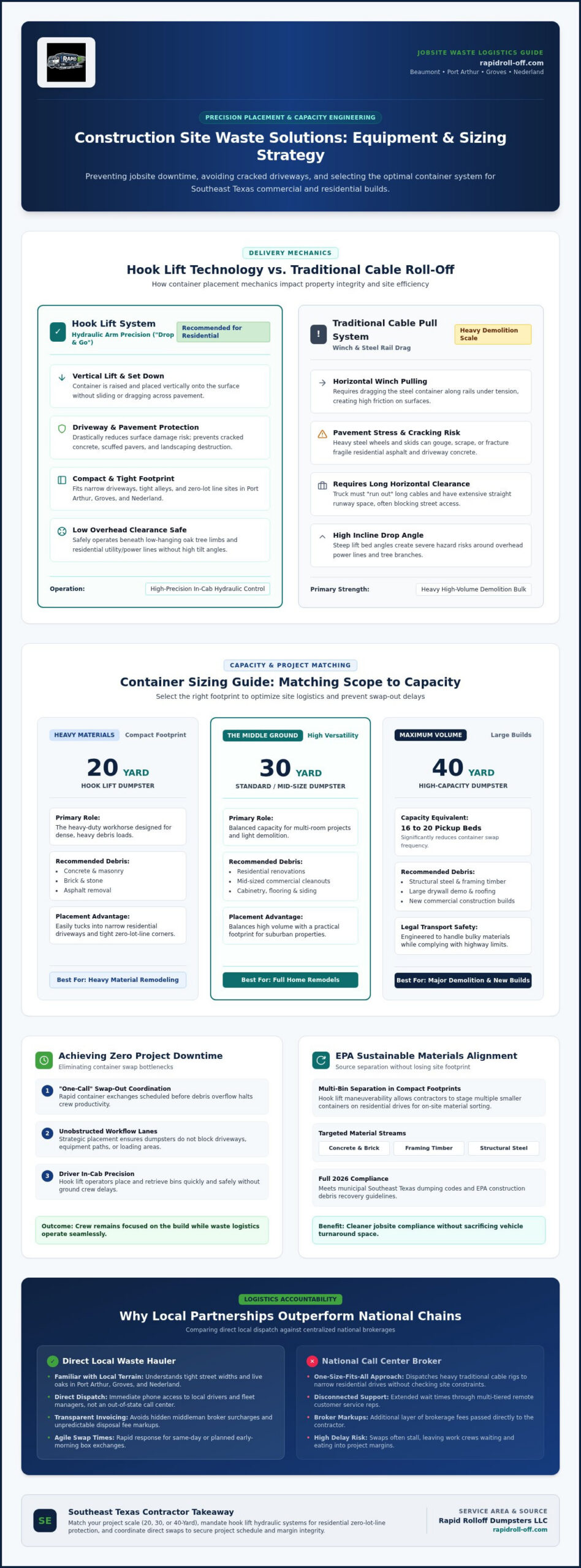
Hook lift systems are quickly becoming the preferred choice for residential contractors in Groves and Nederland. Unlike traditional cable systems that pull a container up a rail, a hook lift uses a hydraulic arm to lift and set the bin down vertically. This mechanism provides incredible control during delivery. It allows drivers to place a 20 or 40-yard container in narrow driveways or tight alleys where a larger truck might struggle. Because the container is lifted rather than dragged, there’s a much lower risk of damaging the client’s property or scuffing the pavement. Safety is also improved for ground crews since the driver can operate the system with high precision from the cab.
Standard Roll-Offs for Major Demolition
When you’re managing a major commercial project in Beaumont, capacity and durability are your primary concerns. High-volume demolition generates massive amounts of bulky debris like structural steel, timber, and drywall. Standard containers are built to withstand these heavy loads without buckling. Understanding roll-off dumpster dimensions and capacities is vital for planning your site footprint. Using a 40-yard unit ensures you have the volume of 16 to 20 pickup truck beds, reducing the frequency of swaps. Implementing the right construction site waste solutions for these large builds means choosing a bin that can handle the weight of structural steel while staying within legal transport limits. This organized approach keeps your Beaumont job site professional and efficient.
Comparing Hook Lift vs. Traditional Roll-Off Systems
Choosing the right delivery method is just as important as choosing the right container size. Many national waste brokers treat every bin as if it’s the same, but the mechanics of how that bin reaches the ground can impact your project’s bottom line. For local contractors, understanding the difference between sliding and lifting is a key part of effective construction site waste solutions. Traditional cable systems rely on a winch to pull the container up or slide it down long steel rails. This creates a high degree of friction and requires a significant amount of horizontal space to maneuver the truck and the box.
Hook lift systems operate with a hydraulic arm that physically lifts the container and sets it down vertically. This “drop and go” approach offers superior weight distribution. Since the bin isn’t dragged across the pavement, the risk of surface damage is drastically reduced. This precision is essential when you’re following roll-off dumpster dimensions and capacities to plan a tight site. It also aligns with EPA sustainable construction material management guidelines by allowing you to place multiple smaller bins for on-site sorting without taking up the entire footprint of a driveway.
Why Hook Lifts Win for Residential Construction
Residential projects in Groves and Nederland often feature narrow driveways and zero-lot lines. A 20-yard hook lift dumpster is ideal here because the truck doesn’t need to “run out” a long cable to place the bin. You can tuck the container into tight corners that a traditional rig simply can’t reach. This precision helps you avoid scraping the customer’s concrete or damaging expensive landscaping. In Port Arthur, where low-hanging oak limbs and power lines are common, the controlled lift of a hook system provides a safer alternative to high-angled cable drops. If you’re working in a neighborhood with strict space constraints, you can view local hook lift options to see how they fit your specific site.
When Traditional Roll-Off is the Better Choice
Traditional roll-off systems still hold a place on large-scale commercial builds in Beaumont. When you’re managing massive 30-yard or 40-yard volume requirements, the standard cable system is a reliable workhorse. These containers are built for the heavy-duty demands of structural steel and high-volume timber demolition. On open sites where space is not an issue, the traditional delivery method is highly efficient for rapid swap-outs. The simplicity of the cable system allows for quick turnarounds when your crew is generating debris faster than a single bin can hold. This ensures your construction site waste solutions keep pace with heavy machinery and high-speed demolition schedules.
Sizing Your Site Solution: 20, 30, and 40-Yard Guide
Selecting the right container size involves more than just estimating volume. You must account for the density of your materials to stay within legal hauling limits and avoid overage fees. In Southeast Texas, where heavy clay soil and dense roofing materials are common, choosing the wrong bin can lead to logistical delays. Effective construction site waste solutions require a balance between physical space and weight capacity. While a 40-yard container offers the most room, it isn’t always the best choice for heavy masonry or concrete.
- 20-Yard Hook Lift Containers: Best for dense, heavy materials like dirt, sand, or shingles.
- 30-Yard Containers: The standard choice for mid-sized renovations and framing projects.
- 40-Yard Hook Lift Containers: Reserved for massive commercial builds and high-volume demolition.
Adhering to OSHA construction waste disposal standards is a critical part of site safety. These regulations require regular removal of scrap and debris to keep walkways clear and prevent fire hazards. Planning your container size around these safety requirements ensures your Beaumont or Port Arthur job site remains compliant and productive.
The 20-Yard Hook Lift: A Roofer’s Best Friend
Roofing contractors in Groves often prefer the 20-yard hook lift for its precision and weight capacity. For a standard asphalt shingle tear-off, you can typically fit 20 to 30 squares of shingles into one of these bins. It’s important to remember that shingles are incredibly heavy. Filling a larger 40-yard bin with shingles would likely exceed the TxDOT 80,000-pound gross vehicle weight limit. Using a 20-yard bin prevents the truck from “bottoming out” during pickup and protects your client’s driveway from the extreme pressure of an overloaded container. Place these bins directly under a roof edge or debris chute to minimize labor hours spent hauling waste across the site.
Scaling Up: 30 and 40-Yard Commercial Needs
For large-scale commercial projects or multi-family residential builds in Beaumont, volume is the priority. A 40-yard hook lift dumpster provides enough space for bulky debris like structural timber, siding, and large amounts of drywall. These units hold the equivalent of 16 to 20 pickup truck beds, making them the ultimate construction site waste solutions for high-velocity projects. When your crew is clearing a lot or managing a full-scale demolition, a 30-yard container acts as a reliable middle ground. It handles the overflow of mid-sized framing jobs without taking up the massive footprint of a 40-yard unit. To keep these large projects moving, establish a “one-call” swap-out schedule to ensure an empty bin is always ready when the current one reaches its limit.
Strategic Waste Management for SE Texas Contractors
Efficient logistics transform a dumpster from a simple container into an indispensable tool for productivity. Strategic construction site waste solutions focus on reducing the time your crew spends handling debris across jobsites in Beaumont, Port Arthur, and Nederland. Start by optimizing the placement of your bin. Position the dumpster as close to the primary work zone as possible to minimize labor hours lost to hauling scrap across the site. In residential neighborhoods throughout Groves and Port Neches, this often means using a versatile hook lift system to tuck the bin safely into a driveway or side yard rather than blocking the street.
Implementing a “one-call” swap-out strategy prevents your framing or demo crew from stalling. National broker call centers often require 48 to 72 hours of lead time for a haul, but a dedicated local team understands that a full bin halts progress immediately. Coordinate with your dispatch driver to establish a trigger point for box swaps, such as when the container reaches three-quarters capacity. This proactive planning ensures your team never stands idle waiting for an empty container.
Local Knowledge: Beaumont and Port Arthur Logistics
Building in Beaumont, Port Arthur, and surrounding Jefferson County communities requires navigating distinct coastal conditions. Dense clay soil and frequent coastal humidity can turn an active jobsite into a slick mud pit after a sudden downpour. Hook lift trucks are lighter and more maneuverable than traditional heavy cable rigs, substantially lowering the risk of rutting soft lawns or getting stuck on Port Arthur jobsites. You must also account for municipal ordinances. For instance, placing a roll-off container on a public street in Beaumont often requires a right-of-way permit, whereas private driveway placement does not. Local haulers understand these local codes and help you avoid unnecessary fines.
Cost Reduction Through Smart Loading
You can lower your total disposal expenses by training your subcontractors on efficient loading practices. Avoid the “air pocket” trap where bulky framing cutoffs or large fixtures create void spaces at the bottom of the container. Place flat materials like drywall panels and plywood sheets across the floor, then stack heavier debris on top to compress the load. When managing concrete, brick, or excavated soil, keep those streams separate from general trash, as clean-fill materials often qualify for discounted tipping rates. Overweight fees are additional charges applied when a container exceeds its contracted tonnage limit, but you can avoid them on dense masonry projects by renting dedicated 20-yard heavy-material bins. To keep your next build running on schedule, schedule a local site assessment with Rapid Rolloff Dumpsters LLC today.
Why Local Partnerships Outperform National Chains
Local partnerships offer a level of accountability that national chains simply cannot match. When you call a massive waste broker, you often reach an automated system or a representative in a different time zone. They don’t know the specific layout of a job site in Nederland or the traffic patterns on Highway 69. Choosing local construction site waste solutions means you speak directly with the people managing your equipment. This direct line of communication eliminates the guesswork and ensures your instructions are followed precisely. You get answers from real people who understand the logistical challenges of Southeast Texas.
Response time is another critical factor for builders in our region. Southeast Texas is prone to sudden severe weather that can disrupt even the best-laid plans. Local providers can pivot quickly to provide emergency storm cleanup or rapid swaps before a tropical system arrives. Supporting a local business also keeps your project dollars within the community. This strengthens the economy in Beaumont, Port Arthur, and Groves while ensuring you have a partner who is genuinely invested in your project’s success.
- Direct Communication: Skip the call centers and speak with local dispatchers.
- Faster Response: Benefit from shorter travel distances for emergency swaps.
- Local Expertise: Work with drivers who know the permit rules in Orange and Jefferson County.
- Community Impact: Keep your construction spending within the SE Texas economy.
Rapid Rolloff Dumpsters LLC: Your Local Construction Partner
As a family-owned business based in Groves, Rapid Rolloff Dumpsters LLC is deeply invested in the success of our neighbors. We understand that construction timelines are dynamic. Schedules often change based on the weather or subcontractor availability. Our specialized inventory of 20 and 40-yard hook lift dumpsters is tailored for the tight residential and commercial sites found throughout our area. We offer the flexibility you need to adjust your haul schedule without the hassle of corporate red tape. Whether you need a 30-yard dumpster for a framing project or a 20-yard hook lift for a roofing job, we provide reliable equipment that arrives on time.
Streamlining Your Next Project
Starting a partnership with a local provider is a straightforward process that saves you time and money. Rapid Rolloff Dumpsters LLC works with long-term contractors to develop customized construction site waste solutions that account for every phase of your build. This collaborative approach ensures you always have the right bin for the right material, from initial clearing to final punch-out. You can visit the Rapid Rolloff Dumpsters LLC homepage to request a quote on your next build and experience the difference of a local partnership. By prioritizing clear pricing and dependable service, we help you maintain a clean, safe, and efficient job site from start to finish.
Build a More Efficient Job Site in 2026
Managing a successful project in the Golden Triangle requires a logistics partner who understands the local terrain. Throughout this guide, we’ve explored how precision equipment and strategic planning prevent the bottlenecks that often stall commercial and residential builds. By implementing smarter construction site waste solutions, you protect your client’s property while maintaining your own profit margins. Whether you are navigating a tight residential lot or a high-volume demolition, the right container choice keeps your crew focused on the build rather than the debris.
Rapid Rolloff Dumpsters LLC is locally owned and operated in Groves, TX. We specialize in hook lift delivery systems that handle the tightest sites across Port Arthur, Beaumont, and the surrounding communities. Don’t let logistical delays or equipment damage compromise your professional reputation. Get a Reliable Construction Waste Solution from Rapid Rolloff Dumpsters LLC and build with the confidence that comes from a dependable local partnership. We look forward to supporting your next project with the efficiency and reliability your business deserves.
Frequently Asked Questions
What is the best dumpster size for a roofing project in Beaumont?
A 20-yard hook lift dumpster is the industry standard for roofing projects in Beaumont. Asphalt shingles are extremely dense, so a smaller container prevents the load from exceeding TxDOT weight limits. One 20-yard bin typically holds between 20 and 30 squares of shingles. Using a larger container for this specific material often leads to hauling issues or driveway damage due to the extreme weight concentration.
Can a hook lift dumpster be placed in a tight residential driveway?
Yes, a hook lift dumpster is specifically designed for tight residential driveways in areas like Groves and Nederland. The hydraulic arm lifts the container vertically and sets it down with high precision. This eliminates the need for the long staging area required by traditional cable trucks. It also prevents the container from being dragged across the concrete, which helps protect your client’s property from unsightly scrape marks.
How do I avoid overweight fees on a construction site?
Avoiding overweight fees requires matching your debris type to the correct container capacity. For heavy materials like concrete, brick, or dirt, always use a 20-yard bin rather than a 30 or 40-yard model. Larger bins filled with dense waste will quickly exceed legal road weight limits. You should also keep your waste level with the top of the container to ensure safe transport and avoid additional handling charges.
Are there specific items I cannot put in a construction dumpster in Groves?
You cannot dispose of hazardous materials in a construction dumpster in Groves. Prohibited items include paints, solvents, batteries, tires, and appliances containing freon. You must also avoid placing chemicals or flammable liquids in the bin. If your project involves these materials, contact local recycling centers in Jefferson County for specialized disposal. Keeping these items out of your bin ensures your construction site waste solutions remain compliant with landfill regulations.
How quickly can I get a dumpster delivered to a site in Port Arthur?
Because Rapid Rolloff is based locally in Groves, we provide faster response times for sites in Port Arthur and Beaumont than national brokers. Most deliveries are scheduled within 24 to 48 hours, though we often accommodate same-day or next-day requests depending on current inventory. Local dispatchers can coordinate directly with your site manager to ensure the container arrives exactly when your crew is ready to start.
Do I need a permit to place a dumpster on the street in Nederland?
You generally need a permit if the dumpster will sit on a public street or right-of-way in Nederland. If the container is placed entirely on private property, such as a driveway or a designated job site footprint, a permit is usually not required. We recommend checking with the City of Nederland building department to verify current local ordinances before scheduling your delivery to avoid any municipal fines or project delays.
What is the difference between a roll-off and a hook lift container?
The primary difference lies in the loading mechanism. Traditional roll-off trucks use a cable and winch system to pull a container onto the truck rails, which requires a shallow angle and significant space. Hook lift systems utilize a hydraulic arm to lift the bin vertically. This allows for more precise placement in tight Southeast Texas neighborhoods and offers better control, making it one of the most versatile construction site waste solutions available.
How do I estimate the weight of construction debris?
Estimating debris weight involves calculating the volume and density of your waste materials. For example, a cubic yard of clean concrete weighs approximately 4,000 pounds, while a cubic yard of loose construction debris typically averages around 350 pounds. If you are tearing off a roof, remember that three-tab shingles weigh about 240 pounds per square. Using these benchmarks helps you select the right bin size and avoid exceeding hauling limits.