What if the biggest risk to your Beaumont construction project isn’t the deadline, but the 40,000-pound box sitting on your fresh asphalt? It’s a common concern for site managers who need efficient debris removal but worry about property damage. You want a waste solution that shows up on time without leaving behind cracked concrete or a trail of hidden overage fees. Managing commercial roll off containers should be the easiest part of your job, not a source of logistical stress.
We understand that local accountability matters when you’re balancing tight schedules in Port Arthur or Groves. This guide shows you how to select the perfect container size for your debris volume while protecting your site using specialized hook lift technology. You’ll learn how to minimize waste costs and navigate local disposal regulations with confidence. We’ll break down the differences between 20, 30, and 40-yard options so you can choose the most efficient fit for your next commercial project.
Key Takeaways
- Identify the right capacity for your project by comparing the specific dimensions and weight limits of 20, 30, and 40-yard units.
- Protect your parking lot or job site from structural damage by utilizing specialized hook lift technology for precise, vertical container placement.
- Navigate municipal permit requirements for commercial roll off containers in Beaumont, Port Arthur, and Groves to avoid costly project delays.
- Streamline your waste budget by partnering with a local SE Texas provider that offers direct accountability and predictable pickup schedules.
Understanding Commercial Roll Off Containers for SE Texas Businesses
A commercial roll-off container is a heavy-duty, open-top waste receptacle designed for large-scale projects. Unlike the permanent bins you see behind restaurants for daily trash, these are temporary solutions. They are delivered by specialized trucks and “rolled off” into place. Understanding what a roll-off container is helps you distinguish between standard waste pickup and the high-capacity needs of a job site. These units are built to handle thousands of pounds of debris without buckling.
Businesses in Groves and Port Arthur operate in a unique industrial environment. You deal with everything from refinery-related construction to coastal weather cleanup. Local expertise is vital. National call centers don’t understand the specific logistics of our local streets or the humidity-driven weight of debris. Using commercial roll off containers that are sized correctly prevents site overflows and keeps your project moving. It ensures you have the right tool for the specific volume of waste your business generates.
Beaumont’s economy relies on sectors like petrochemicals, healthcare expansion, and retail development. These industries generate massive amounts of waste that require 20, 30, or 40-yard capacities. Permanent bins are for consistent, low-volume waste; temporary roll-offs handle the heavy lifting. Think of it as the difference between a kitchen trash can and a massive industrial tool. One is for convenience; the other is for project success.
The Role of Roll-Offs in Construction and Demolition
Construction sites are high-traffic areas where safety is the priority. Heavy debris like concrete, roofing shingles, and steel beams can’t sit in piles. It’s a hazard. Efficient commercial roll off containers provide a central point for all waste. This keeps the ground clear for workers and machinery. By choosing a larger 40-yard unit, you reduce the frequency of hauls. This keeps your crew focused on building rather than waiting for a truck to swap a full bin. It also helps you stay compliant with local waste regulations by preventing illegal dumping or overflow.
Commercial Property Management and Retail Cleanouts
Retail managers often face tight deadlines during tenant turnovers or renovations. Standard commercial pickup won’t accept a pile of old shelving or carpet. You need a fast, reliable drop-off. Timely delivery ensures your renovation team doesn’t lose a day of work. Precision placement is also key. You need the container close to the exit but away from customer parking. Our hook lift systems for 20 and 40-yard units allow for this level of accuracy, even in tight commercial spaces. This specialized delivery method prevents the scraping and damage often associated with traditional cable-pull systems.
Sizing Your Container: 20, 30, and 40 Yard Capacity Guide
Selecting the right size for your large waste container rental isn’t just about how much stuff you have. It’s about how much that debris weighs. If you’re managing a refinery site in Port Arthur or a retail strip in Beaumont, your waste profile changes significantly. You must account for the “Weight vs. Volume” rule. Dense materials like concrete or roofing shingles hit weight limits long before they fill the bin’s physical space. Conversely, bulky items like insulation or office furniture require maximum volume. Following federal guidelines for waste collection ensures your site stays safe and compliant while avoiding the logistical headache of an overloaded unit.
The 20-Yard Container: Best for Heavy Materials
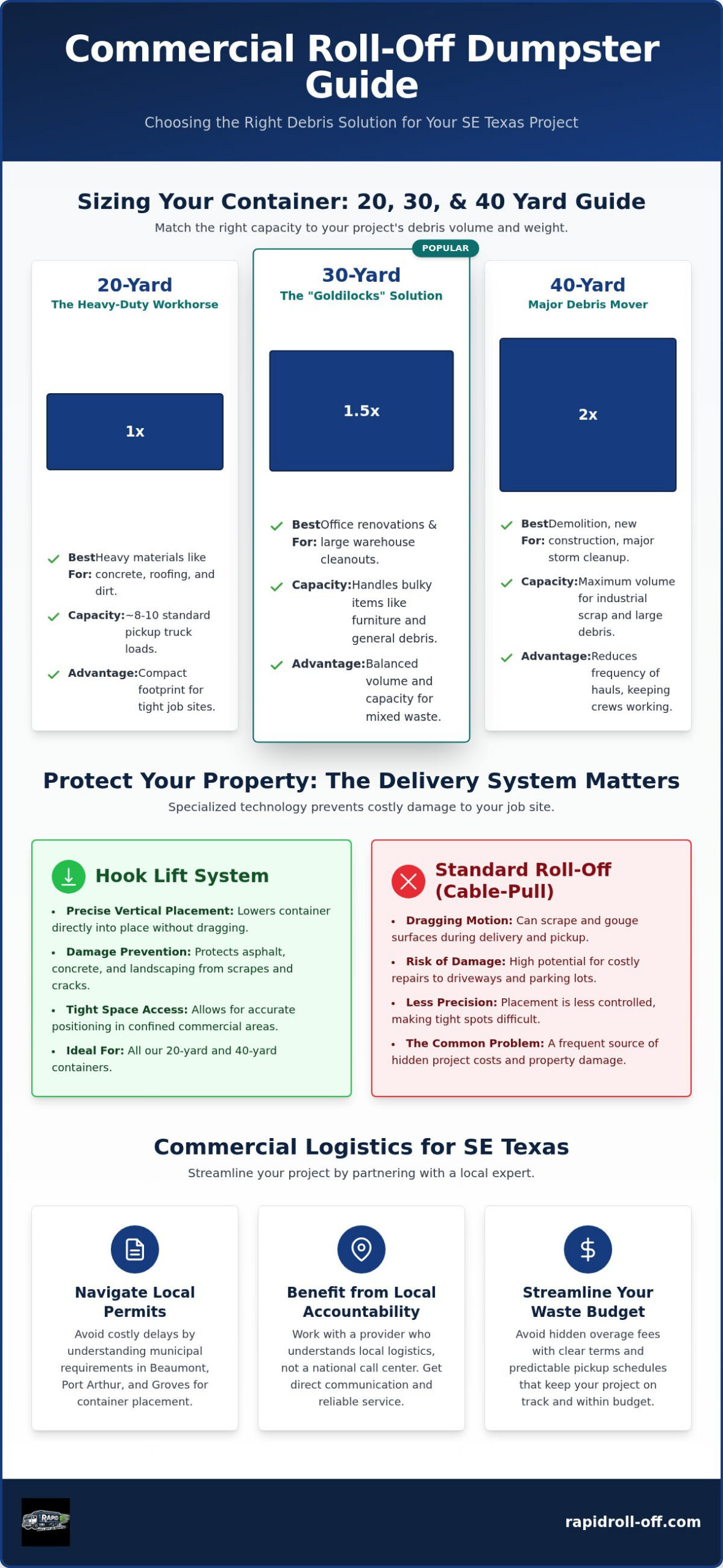
This is the workhorse for heavy-duty SE Texas projects. It’s the ideal choice for roofing replacements in Nederland or concrete removal in Groves. Because of its smaller footprint, it fits easily into tight commercial parking lots without blocking traffic flow. Our 20-yard hook lift system allows for precise placement, keeping the container away from sensitive structures or fresh landscaping. A 20-yard container holds approximately eight to ten standard pickup truck loads of debris. It’s compact but powerful.
The 30 and 40-Yard Containers: Major Debris Solutions
For larger projects, you need more room to breathe. The 30-yard container is the “Goldilocks” size for office renovations and large-scale warehouse cleanouts. It handles the bulk of commercial furniture and general construction debris without needing constant hauls. When you’re facing total demolition or massive storm cleanup after a Gulf weather event, the 40-yard container becomes essential. These high-capacity units are perfect for industrial scrap and large-scale new construction. Our 40-yard units also utilize hook lift technology, ensuring we can place even these massive containers exactly where your crew needs them.
Accurately estimating your waste output is the best way to avoid hidden overage fees. Don’t guess on the size. A container that’s too small leads to multiple trips and higher costs, while one that’s too large wastes valuable site space. If you’re unsure which capacity fits your project, consult with a local specialist to ensure you get the most efficient waste solution for your budget.
Hook Lift vs. Standard Roll-Off: Choosing the Right Delivery System
Most project managers assume all commercial roll off containers arrive the same way. This is a mistake that can lead to unexpected property damage. Standard cable-pull systems rely on a winch to drag the container off the truck’s bed. This creates significant friction and horizontal pressure on your surface. Hook lift systems use a hydraulic arm to lift the container vertically and set it down with surgical precision. This mechanical difference is the key to protecting your investment. Understanding these delivery methods helps you maintain a safer, cleaner job site.
Precision Placement in Tight Commercial Spaces
Tight spaces in Port Arthur or Beaumont require accuracy that standard trucks often can’t provide. Cable-pull trucks need a long “runway” to slide a container into place. This makes them difficult to use in narrow alleys or between existing structures. Hook lift technology allows the driver to back into a spot and drop the unit exactly where you need it. This vertical motion eliminates the scraping that ruins asphalt. It allows for placement in loading zones and cramped retail corners where a traditional truck simply wouldn’t fit. You get the waste capacity you need without blocking essential traffic flow.
The most common fear for property managers is that a heavy container will crack expensive concrete. It’s a valid concern. When a 40,000-pound box is dragged across a surface, the risk of gouging or structural failure is high. Hook lift technology addresses this objection directly. By controlling the descent, the driver places the weight gradually. The hydraulic arm ensures the container lands softly rather than letting gravity and friction do the work. This gentle placement is a requirement for professional office parks and high-traffic retail centers where appearance matters.
Site-Safe Technology for Professional Environments
Professional environments demand a higher level of care. You don’t want a waste removal service to leave behind permanent scars on your fresh parking lot. Rapid Rolloff specializes in hook lift delivery for our 20 and 40-yard units because it’s the “parking-lot-friendly” choice. This method minimizes the footprint of the delivery truck during the drop-off. It protects decorative concrete and fresh asphalt from the damage typically associated with industrial waste hauling. Choose hook lift delivery when your site’s integrity is just as important as the debris you’re removing. It’s a straightforward way to ensure a stress-free experience for your team and your tenants.
Commercial Logistics: Permits, Placement, and Preparation
Successful management of commercial roll off containers starts long before the truck arrives on your site. You need to account for municipal rules and physical site constraints to avoid fines or project delays. Every city in the Beaumont-Port Arthur area has its own set of ordinances regarding temporary structures and waste storage. Proper planning ensures that your waste solution remains an asset rather than a logistical hurdle. It keeps your crew productive and your project compliant with local standards.
Permit and Regulation Checklist
You typically need a permit if you plan to place a container on a public street or right-of-way in Beaumont or Port Arthur. If the container stays on private property, like a parking lot or construction site, a street permit is usually unnecessary. However, check with your local building department if the project will last more than 30 days. You must also adhere to strict weight limits enforced by local road authorities. Overloading a container can lead to heavy fines and safety risks during transport. Additionally, SE Texas landfills strictly prohibit certain items, including:
- Paints, solvents, and pesticides
- Automotive fluids and batteries
- Tires and appliances containing refrigerants
- Asbestos-containing materials
Optimizing Container Placement for Efficiency
Strategic placement reduces manual labor for your crew and speeds up the debris removal process. Choose a level, stable surface that can support the weight of a fully loaded container. While our 20 and 40-yard hook lift units offer precise placement, you still need to ensure significant overhead clearance. Avoid spots directly under power lines, low-hanging tree branches, or building overhangs. If you’re placing the unit on fresh asphalt or decorative concrete, use “street pads” or heavy wood blocking to distribute the pressure. This simple step provides an extra layer of protection against surface indentations.
Safety protocols are vital during the loading phase. Always distribute the weight evenly within the container to prevent it from tipping during pickup. Never fill the debris past the “top off” line. Protruding materials are a hazard for our drivers and other motorists on the road. Effective scheduling also prevents site overflow. Don’t wait until the bin is overflowing to call for a swap. Proactive communication helps us maintain your project’s momentum and keeps your job site organized. If you’re ready to schedule a delivery for your next project, contact our local team today to secure your container.
Why a Local Partner is Better for Commercial Waste Management
Choosing the right partner for commercial roll off containers often comes down to who answers the phone. When you call a national waste conglomerate, you’re likely speaking to a representative in a different time zone who has never seen a SE Texas refinery. They see your project as a number on a spreadsheet. A local expert understands that a missed pickup in Beaumont can halt an entire construction crew. This local accountability is what separates a generic service from a true partnership. We prioritize your schedule because we live and work in the same neighborhoods you do. It’s about trust and the knowledge that your waste partner won’t vanish when a logistical challenge arises.
Managing commercial roll off containers effectively requires more than just a truck. Large corporations often struggle with the “last mile” of service. They might promise a delivery window but fail to account for local traffic patterns or specific site quirks in Port Arthur. Our team knows the streets of Groves and the industrial zones of Beaumont intimately. This geographic expertise translates to fewer delays and more precise service. You don’t have to explain the layout of a local industrial park to someone who has never been there. We arrive prepared with the right equipment and a plan for your specific location.
Reliability When It Matters Most
Commercial timelines are rigid. You can’t afford to have workers standing around because a bin is full. Local dispatching allows for much faster response times than national call centers can offer. You get direct communication with the people actually moving the trucks. If a site condition changes, you don’t have to wait on hold for twenty minutes to explain it to a third party. We offer the flexibility that large-scale operators simply can’t match. This responsiveness ensures your debris removal stays ahead of your project’s needs. We aim for same-day or next-day delivery whenever possible to keep your site moving and organized.
Supporting the SE Texas Economy
Investing in local businesses like Rapid Rolloff keeps resources within the Golden Triangle. We understand the specific challenges faced by SE Texas contractors, from humidity-heavy debris to hurricane recovery logistics. Our services are tailored to the small businesses and property managers who drive our local economy. You aren’t just getting a dumpster; you’re getting a partner invested in the success of your project. We offer customized waste solutions that respect your budget and your site’s integrity. Supporting local means better service and a stronger community for everyone. Request a commercial quote from Rapid Rolloff today and experience the difference of a local waste partner.
Streamline Your Next SE Texas Project
Managing a commercial site requires precision and a partner you can trust. You’ve learned that selecting the right capacity between 20, 30, and 40-yard units is essential for maintaining a clear budget and a safe job site. Beyond volume, the delivery method determines the long-term health of your property. Our specialized hook lift system provides the vertical placement needed to protect fresh asphalt and concrete from the damage often caused by dragging. By prioritizing local expertise, you gain a partner that understands the unique logistics of Beaumont and Port Arthur.
We’re ready to help you optimize your waste strategy with reliable commercial roll off containers and a proactive approach to service. Our local inventory in Groves, TX, ensures we can respond quickly to your project’s evolving needs. Don’t let debris removal become a source of stress or a bottleneck for your crew. Get a Commercial Roll Off Quote for Your Next Project and secure a site-safe solution today.
Your project deserves a waste partner that is as invested in its success as you are. We look forward to helping you keep your workspace clean and your schedule on track.
Frequently Asked Questions
What is the difference between a hook lift and a standard roll-off container?
A hook lift system uses a hydraulic arm to lift the container vertically and set it down precisely. Standard roll-off systems use a cable and winch to drag the container off the truck bed. Hook lifts are significantly better for tight commercial spaces in Groves because they don’t require a long runway to slide the unit into place. This vertical motion reduces the risk of scraping your asphalt or gouging fresh concrete during delivery.
How much weight can a 40-yard commercial roll-off container hold?
A 40-yard container holds 40 cubic yards of material, but weight is the critical factor. Most 40-yard commercial roll off containers have a weight limit between five and six tons. Exceeding this limit can damage the truck or lead to fines on Beaumont city streets. It’s best used for bulky items like furniture, insulation, or light construction debris rather than dense materials like brick or concrete which quickly exceed weight capacities.
Do I need a permit for a dumpster in Beaumont or Port Arthur?
You generally don’t need a permit if the container stays on your private job site or parking lot. However, if you must place it on a public street or sidewalk in Port Arthur or Beaumont, a right-of-way permit is required. Check with your local municipal office to verify current fees and duration limits. We recommend placing containers on your own property whenever possible to simplify the logistics and avoid extra paperwork.
Can I put concrete and heavy debris in a 40-yard dumpster?
Don’t put concrete or heavy dirt in a 40-yard unit. The weight of these materials would make the container too heavy for any truck to lift safely. For heavy debris like concrete, brick, or roofing shingles, we recommend our 20-yard commercial roll off containers. These smaller units are designed to handle the massive weight of dense materials while staying within legal road limits for transport through Nederland and Port Neches.
What are the typical dimensions of a 30-yard commercial container?
Typical dimensions for a 30-yard container are 22 feet long, 8 feet wide, and 6 feet high. This size is often called the “Goldilocks” option because it’s large enough for major office cleanouts but small enough to fit in most commercial loading zones. It provides a balanced solution for contractors who need more volume than a 20-yard unit but don’t have the space for a massive 40-yard container on their site.
How do I prevent damage to my parking lot when renting a dumpster?
The most effective way to prevent damage is to choose a hook lift delivery system for your project. Unlike cable-pull trucks that drag the bin, hook lifts set the container down vertically. You should also place heavy plywood or specialized “street pads” under the contact points to distribute the weight. This is especially important for fresh asphalt in retail centers or decorative concrete in professional office parks across the Golden Triangle.
What items are prohibited in commercial roll-off containers in SE Texas?
You can’t dispose of hazardous materials, liquid waste, or certain industrial items in a standard container. Prohibited items include tires, lead-acid batteries, paints, solvents, and appliances containing refrigerants like Freon. These items require specialized disposal at dedicated facilities to comply with TCEQ regulations. If you’re unsure about a specific material from your Groves job site, it’s always best to ask our dispatchers before loading it into the bin.
How much space does the truck need to deliver a commercial container?
Delivery trucks generally require about 60 feet of straight-line space to drop or pick up a container. You also need approximately 23 feet of vertical clearance to account for the truck’s bed being raised. If your site in Port Arthur has low-hanging power lines or tree branches, you’ll need to find a different placement. Hook lift systems offer a slight advantage here because they require less horizontal “runway” space than traditional cable-pull systems.